

Selections from Jacques Ellul´s 1965 classic Propaganda - The Formation of Men´s Ideas.
Continuous...
Successful propaganda will occupy every moment of the individual's life: through posters and loudspeakers when he is out walking, through radio and newspapers at home, through meetings and movies in the evening. The Individual must not be allowed to recover, to collect himself, to remain untouched by propaganda during any relatively long period, for propaganda is not the touch of the magic wand- It is based on constant impregnation.
It creates convictions and compliance through imperceptible influences that are effective only by continuous repetition. It must create a complete environment for the individual, one from which he never emerges. And to prevent him from finding external points of reference, it protects him by censoring everything that might come in from the outside. The slow building up of reflexes and myths, of psychological environment and prejudices, requires propaganda of very long duration. Propaganda is not a stimulus that disappears quickly; it consists of successive impulses and shocks aimed at various feelings or thoughts
Horizontal...
Horizontal propaganda is a much more recent development. We know it in two forms: Chinese propaganda and group dynamics in human relations...
Horizontal propaganda is a much more recent development. We know it in two forms: Chinese propaganda and group dynamics in human relations...
This propaganda can be called horizontal because it is made inside the group (not from the top), where in principle, all individuals are equal and there is no leader. The individual makes contact with others at his own level rather than with a leader; such propaganda therefore always seeks "conscious adherence." Its content is presented in didactic fashion and addressed to the intelligence. The leader, the propagandist, is there only as a sort of animator or discussion leader; sometimes his presence and his identity are not even known – for example, the "ghost writer" in certain American groups, or the "police spy" in Chinese groups. The individual's adherence to his group is "conscious" because he is aware of it and recognizes it, but it is ultimately involuntary because he is trapped In a dialectic and in a group that Leads him unfailingly to this adherence. His adherence is also "intellectual" because he can express his conviction clearly and lineally, but it is not genuine because the information, the data, the reasoning that have led him to adhere to the group were themselves deliberately falsified in order to lead him there.
This form of propaganda needs two conditions: first of allr a lack of contact between groups. A member of a small group must not belong to other groups in which he would be subjected to other influences that would give him a chance to find himself again andh with ith the strength to resist. This is why the Chinese Communists insisted On breaking up traditional groups, such as the family. A private and heterogeneous group (with different ages, sexes and occupations) like the family is a tremendous obstacle to such propaganda
Integratory...
In contrast to propaganda of agitation is the propaganda of integration—the propaganda of developed nations and characteristic of our civilization; in fact it did not exist before the twentieth century. It is a propaganda of conformity- such propaganda is confined to rationalizing an existing situation, to transforming unconscious actions of members of a society into consciously desired activity that is visible, laudable, and justified— In such cases it must be proved that the listeners, the citizens in general, are the beneficiaries of the resultant socio-political development
Integration propaganda aims at stabilizing the social body, at unufying and reinforcing it. It Is thus the preferred Instrument of government, though properly speaking it is not exclusively political propaganda. Since 1930 the propaganda of the Soviet Union, at well as that since the war. of all the People's Republics, has been a propaganda of integration. But this type of propaganda can also he made by a group of organization other than those of government, going in the same direction, more or less spontaneously. more or less planned by the state.
The most important example of the use of such propaganda is the United States. Obviously integration propaganda is much more subtle and complex than agitation propaganda. It seeks not a temporary excitement but a total molding of the person in depth. Here all psychological and opinion analyses must be utilized, aswell as the mass media of communication ...
The most important example of the use of such propaganda is the United States. Obviously integration propaganda is much more subtle and complex than agitation propaganda. It seeks not a temporary excitement but a total molding of the person in depth. Here all psychological and opinion analyses must be utilized, aswell as the mass media of communication ...
Generally, only one element—hatred—can be immediately satisfied; everything else must be changed. Obviously, this conversion of propaganda is very difficult: the techniques and methods of agitation propaganda cannot be used; the same feelings cannot be aroused Other propagandists must be employed as totally different qualities are required for integration propaganda. The greatest difficulty is that agitation propaganda produces very rapid and spectacular effects, whereas integration propaganda acts slowly, gradually, and imperceptibly. After the masses have been subjected to agitation propaganda, to neutralize their arousod impulses with integration propaganda without being swept away by the masses is a delicate problem.
Irreversable..
What is needed, then, is continuous agitation produced artificially even when nothing in the events of the day justifies or arouses excitement. Therefore, continuing, propaganda must slowly create a climate first, and then prevent the individual from noticing a particular propaganda operation in contrast to ordinary daily events.
For action makes propaganda's effect irreversible.He who acts in obedience to propaganda can never go back. He is now obliged to believe in that propaganda because of his past action. He is obliged to receive from it his justiiication and authority, without which his action will seem to him absurd or unjust, which would be intolerable. He is obliged to continue to advance in the direction indicated by propaganda, for action demands more action. He is what one calls committed. The man who has acted in accordance with the existing propaganda has taken his place in society. From then on he has enemies. Often he has broken with his milieu or his family. He may be compromised. He is forced to accept the new milieu and the new friends that propaganda makes for him. Often he has committed an act reprehensible by traditional moral standards and has disturbed a certain order. He needs a justification for this —and he gets more deeply involved by repeating the act In order to prove that it was just. Thus he is caught up in a movement that develops until it totally occupies the breadth of his conscience Propaganda now masters him completely—and we must bear in mind that any propaganda that does not lead to this kind of participation is mere child's play.
Ellul, Jacques - Propaganda. the Formation of Men's Attitudes
For action makes propaganda's effect irreversible.He who acts in obedience to propaganda can never go back. He is now obliged to believe in that propaganda because of his past action. He is obliged to receive from it his justiiication and authority, without which his action will seem to him absurd or unjust, which would be intolerable. He is obliged to continue to advance in the direction indicated by propaganda, for action demands more action. He is what one calls committed. The man who has acted in accordance with the existing propaganda has taken his place in society. From then on he has enemies. Often he has broken with his milieu or his family. He may be compromised. He is forced to accept the new milieu and the new friends that propaganda makes for him. Often he has committed an act reprehensible by traditional moral standards and has disturbed a certain order. He needs a justification for this —and he gets more deeply involved by repeating the act In order to prove that it was just. Thus he is caught up in a movement that develops until it totally occupies the breadth of his conscience Propaganda now masters him completely—and we must bear in mind that any propaganda that does not lead to this kind of participation is mere child's play.

Saul Alinsky´s creepy booklet on how to subvert free societies through deceit and community organizing. I have rarely read a book with more open references to the "diabolic" aspects of communist strategy of rebellion. I remember when I first picked up the book I thought the famous "dedication to Lucifer" was just a cameo. But on closer inspection I soon found that his favoring of lies and deceit, his opportunistic morality, relativism and sheer pleasure in theft and extortion, actually make up the whole premise of his enterprise.
- Lucifer really seems to have been a genuine inspiration for Alinsky, in the usual sense of the word.
The most telling example of the thinking of this hero of the modern self-righteous left, might be his tenth rule of the ethics of means and ends:
The tenth rule of the ethics of means and ends is that you do what you can with what you have and clothe it with moral garments.
David Horowitz has some very interesting analysis of how all this plays out in detail and relates to the community organizer and Alinsky-disciple currently running things into the ground from the white house.
I embedded Horowitz Booklet on Obama and the Alinsky model further below, along with an excellent recent 50 minute interview
Alinsky_RulesForRadicals (1)
Aleksandr Solzhenitsyn's book stands as a massive indictment of the evil of Joseph Stalin and of the Communist system, portraying with chilling insight the role of ordinary people in carrying out this evil.
Gulag Archipelago
Solzhenitzyn´s great speech at Harvard - A World Split Apart
Harvard's motto is Veritas. Many of you have already found out and others will find out in the course of
their lives that truth eludes us if we do not concentrate with total attention on its pursuit. And even
while it eludes us, the illusion still lingers of knowing it and leads to many misunderstandings. Also,
truth seldom is pleasant; it is almost invariably bitter. There is some bitterness in my speech today, too.
But I want to stress that it comes not from an adversary but from a friend.
Transcript below
Alexander Solzhenitsyn - A World Split Apart
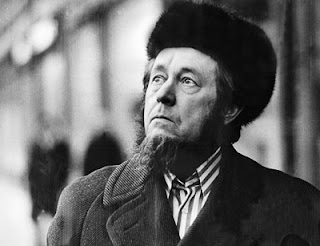
Gulag Archipelago
Solzhenitzyn´s great speech at Harvard - A World Split Apart
Harvard's motto is Veritas. Many of you have already found out and others will find out in the course of
their lives that truth eludes us if we do not concentrate with total attention on its pursuit. And even
while it eludes us, the illusion still lingers of knowing it and leads to many misunderstandings. Also,
truth seldom is pleasant; it is almost invariably bitter. There is some bitterness in my speech today, too.
But I want to stress that it comes not from an adversary but from a friend.
Transcript below
Alexander Solzhenitsyn - A World Split Apart

"Oriana Fallaci's seminal speech (from her 2002 Panorama article of the same title) about European anti-semitism and the unholy alliance between the left and the Islamonazis.
Special thanks to DANIELApuntoEbasta, who uploaded the original video, to whoever translated it in the first place, and especially to to Frank, without whom I could have never survived my learning-to-subtitle adventure.
The original translation, which is the only English translation of Io trovo vergnoso I could find, had several minor errors which I fixed, including entire omitted paragraphs (all in the second video), so this may be the first time you silly Anglophones get to read the whole thing. Youre welcome.
Video originally ripped from http://www.youtube.com/user/DANIELApu... and subtitled by yours truly."
"Yours truly" being the much missed Jdamn, who used to help out a lot here at Kitman TV before she went on to other probably more noble tasks :-)
pssstt!... Orianas Fallaci´s classic The Force of Reason is available as pdf here. (hat tip Al Salibiyya)


Pdf online here
and
PDF available online
In order to dampen assumptions about Joseph Douglass being "conspiratory"" with regard to his conclusions about the KGB drug-raping the free world during the cold-war, I find it important to remind people of the distinction between fact-based research into what groups known to conspire have been doing on the one hand, and speculations about what groups that might be conspiring would be conspiring about. Joseph Douglass book Red Cocaine clearly belongs in the first group.
Joseph Douglass on C-span
About the Author
Dr Joseph Douglass is a national security analyst and author with expertise in defence policy, threat assessment, deception, intelligence and political warfare, nuclear strategy, terrorism, advanced chemical and biological warfare agents and applications, and international narcotics trafficking. Since the mid-1980s, his primary focus has been research into various dimensions of cultural warfare and notably into the illegal drugs plague, with emphasis on its origins, support structures, marketing - and the question: 'What can be done?'
Dr Douglass received his PhD in electrical engineering from Cornell University in
1962 and has taught at Cornell, the Navy Postgraduate School at Monterey, and Johns Hopkins School of Advanced International Relations in Washington, D.C.. He has worked in and for the national laboratories (Sandia Corporation], the US Government, where he was Deputy and Acting Director, Tactical Technology Office, Advanced Research Projects Agency - and with various defence contractors, such as the Institute for Defense Analyses and System Planning Corporation. He is a former member of the Weapons Systems Evaluation Group, US Army Science Board, and a former consultant to the Arms Control and Disarmament Agency and Senate Foreign Relations Committee. He currently directs The Redwood Institute, which was formed to address the internal problems America faces - such as illegal drugs, crime and impoverished education - and to identify root causes, evaluate national policy and devise alternative policy options.
The Author has been a pioneering analyst and is perhaps best known for his ground-
breaking studies of nuclear weapons policy, the impact of precision-guided munitions, the nature of the Soviet nuclear threat, the risks arising from chemical and biological warfare agents, and intelligence aspects of international narcotics trafficking. His unclassified books include The Theater Nuclear Offensive [1976, reprinted ten times]; Soviet Strategy for War in Europe [Pergamon Press, 1980, also translated into and published in German]; Soviet Strategy for Nuclear War [Hoover Institute Press, 1979: numerous printings, translated into and published in Japanese]; CBW: The Poor man's Atomic Bomb [Institute for Foreign Policy Analysis, 1984]; Why the Soviet Union Violates Arms Control Treaties [Pergamon-Brassey's, 1988]; Conventional War and Escalation [The National
Strategy Information Center, 1981]; The Superpowers and Strategic War Termination [co- editor, Pergamon-Brassey's, 1989]; and the present work, originally entitled: Red Cocaine:The Drugging of America [1990]. This new edition has been prepared with a view to meeting continuing demand for the work, in both the United States and elsewhere, following the strategic adjustment completed in 1991 when the Communist strategists switched to pursuing their manic World Revolutionary objectives through covert Communism and a 'new form' of reversible 'state-controlled capitalism' - working, as Lenin taught his 'illuminated' followers, 'by other means'.
From Edward Harle Limited
Drawing on defector information and other intelligence sources, Dr Douglass reveals that the Soviets plotted the global drugs scourge in the 1960s, as a key element of their planned onslaught against the fabric of Western society and culture. By the mid-1960s, the Soviet criminalists had already penetrated the existing drug networks; and where they had encountered resistance, they had set up fresh drug-trafficking organisations and distribution systems. Over the Western Hemisphere, Soviet drug-trafficking ops are controlled by the Cuban Communist Party's Americas Department, which remains to this day under covert Soviet KGB direction. The KGB organises the financial arrangements on behalf of Soviet Military Intelligence (GRU), which directs the drugs offensive on the basis that it is a gigantic sabotage operation – which also happens to provide limitless finance for World Revolutionary purposes, including the financing of terrorism training operations. The Soviets further pre-selected the Western banks, and the individuals within them, that they would require in order to carry out the extensive money-laundering operations that they anticipated: hence the advance placement of Soviet operatives at Bank of New York, Republic National Bank, and other prominent institutions, well ahead of the predicted avalanche of drug-derived liquidity. This was how the Soviets penetrated the principal 'engine room' of Western capitalism – the banking system. The significance of all this for the world’s cohesion was summarised by a senior International Monetary Fund official who has pronounced that 'the drug problem cannot be solved, because if it were now to be fixed, the international financial system would collapse'. Drugs are the most valuable commodity in the world – even more so than oil and gold. The Global Revolution, driven by criminalised revolutionary operatives, is as focused upon control over drug-trafficking as upon dominating energy resources.
* Price: $55.00
* UK [cheques only*]: £40.00*
* ISBN: 1-899798-04-8
* Published in: 1999
* Author: Dr Joseph D. Douglass
Exposes the Soviet dimension of the global drugs offensive. Western drug operations are not addressed in this classic study.
Anatoliy Golitsyn - New Lies for Old: The Communist Strategy of Deception and Disinformation -
This is Anatoliy Golitsyn's shocking book New Lies for Old - The Communist Strategy of Deception and Disinformation (1984) where a top-ranking KGB defector reveals the long-term gameplan and disinformation campaign for the now "dead" Soviet Union and the international socialist revolution as a whole. The author worked in the strategic planning department of the KGB in the rank of Major. In 1961 under the name "Anatole Klimov" he was assigned to the Soviet embassy in Helsinki where he defected to the CIA and was interviewed there by counter-intelligence director James Angleton. Golitsyn provided priceless information about many famous Soviet agents including Kim Philby, Donald Duart Maclean, Guy Burgess, John Vassall, double agent Aleksandr Kopatzky and many others. It was only with his defection that Philby was confirmed as a Soviet mole. But his vast knowledge included not only names but the overall strategy of deception that the communists planned decades ahead. In New Lies For Old he successfully predicted the collapse of the communist bloc years before it actually happened and warned about a long-term deception strategy designed to lull the West into a false sense of security and finally economically cripple and diplomatically isolate the United States. As he writes, the 'liberalization' in the Soviet Union would be spectacular and impressive. Formal pronouncements might be made about a reduction in the communist party's role and its monopoly would be apparently curtailed. If liberalization should be extended to East Germany, demolition of the Berlin Wall might even be contemplated (and it did fell). The European Parliament might become an all-European socialist parliament with representation from the Soviet Union and Eastern Europe. 'Europe from the Atlantic to the Urals' would turn out to be a neutral and socialist Europe
Here is an interesting interview with Anatoliy Golitsyns publisher - Christopher Story
William McIlhany interviews publisher Christopher Story about long term Soviet plans and deceptions. Mr. Story is the publisher of several newsletters including "Soviet Analyst", and books including New Lies for Old and Perestroika Deception, both by Soviet defector Anatoliy Golitsyn. Christopher Story alsorefers to his republishing of Joseph Douglass seminal work Red Cocaine - The drugging of America and the West

Joseph Douglass horrifying book Red Cocain on the communist psycho-political drugwar can be found as pdf here
Go to the original site of the below article
Influencing Behavior and Mental Processes in Covert Operations
Joseph D. Douglass, Jr., PhD
In the early 1950s, U.S. intelligence concluded that the KGB, Soviet intelligence, was working hard to develop "mind control" and behavior modification drugs. Supporting evidence included the public "confessions" of numerous high-ranking communist officials, the high-profile trial in Hungary of Josef Cardinal Mindszenty, who appeared to have been drugged as he confessed to treasonous crimes, and the unusual behavior of American POWs during the Korean War. The filmed testimony of American POWs telling the world that America was evil and that communism was a far superior form of government was an especially compelling example.
On April 10, 1953, Allen W. Dulles, newly confirmed CIA director, alerted a gathering of Princeton alumni to the problem. A "sinister battle for men's minds" was underway, he explained. The Soviets "have developed brain perversion techniques, some of which are so subtle and so abhorrent to our way of life that we have recoiled from facing up to them."
In response, the CIA had decided to initiate its own mind control and behavior modification program. Three days after delivering his wake-up speech, Dulles approved the top secret program MKULTRA. Its primary objectives included the development of psychoactive drugs that would:
° "cause mental confusion";
° "alter personality structure";
° "diminish ambition and working efficiency";
° "promote illogical thinking";
° cause a "euphoria with no subsequent let-down";
° induce "amnesia respecting events immediately preceding and during the use of mind control drugs."
These were in addition to the "truth drugs" (TD) and "loosen-the-tongue" drugs already in development.
The possible use of such drugs on diplomats was an especially serious concern. Ambassador George Kennan saw himself as a likely target and, as later reported by CIA official Peer de Silva, requested and was provided with a suicide pill to use if he were taken captive or began experiencing a serious personality change.
The serious nature of this concern contrasted strongly with the publicity given to MKULTRA when it was exposed during the intelligence witch hunts in the mid-1970s. Then, MKULTRA was portrayed as an internal fiasco featuring the unprofessional testing of LSD drugs on unsuspecting "volunteers." This information caused considerable embarrassment and congressional censure. As investigators searched for more information, they were told that all of the documentation had been destroyed by direction of CIA director Richard Helms just before he left office in early 1973.
At the time, John Marks and Victor Marchetti were putting the finishing touches on their book, The CIA and the Cult of Intelligence, which was about to become the first critical insider book on the CIA. Evidently intrigued by the rumors of CIA mind-control programs, Marks submitted a Freedom of Information Act request for related documents. About two years later, the CIA "found" several boxes of documents --- 16,000 pages --- that they released to Marks. The New York Times commissioned him to write a book on the CIA mind control efforts. His book, The Search for the "Manchurian Candidate," was published in 1979. In it, MKULTRA is portrayed as a collection of unprofessional experiments and LSD tests of a most childish nature. There is zero indication that anything of value had been accomplished either by the CIA or the Soviet KGB. The only contrary indications were first, the large number of respected participating scientific research institutes and medical laboratories and second, two interesting facts that slipped through the censors: namely, by 1957, six drugs had been moved into operational use and had been employed against 33 targets. The CIA refused requests for more information on these data.
To his credit, Marks recognized that his was not the full story. Only a few insiders could write that story and they would not talk. Marks was not given access to any scientific records or to the people involved. Most of the documents were incomplete. Almost all the names had been blacked out with the sole exception of Dr. Sidney Gottlieb, who was obviously the chosen Agency spokesman. Marks castigated Congress for its failure to investigate. Specifically, he described the 1977 Kennedy hearings as "ridiculous" because they did not put any pressure on the CIA to reveal the content of their research. The Senate Select Intelligence Committee, which originally was a partner in the hearings, had "withdrawn" its participation in the investigation, at the request of Senator Goldwater. This was unfortunate because this was the only committee with oversight responsibility. Accordingly, the hearings never got beyond the primitive LSD experiments --- and, there was a world of difference between the farcical LSD testing and the actual development objectives of MKULTRA and the emerging technology.
When MKULTRA was dropped down the memory hole, no one stopped to question what was really known about the Soviet accomplishments. This was a glaring error because there was no logical basis for concluding that the Soviet program was a "bust" and many reasons to lead a prudent person to anticipate just the reverse. The Soviet program was serious and had the backing of the First Secretary, Nikita Khrushchev, himself. The Soviets had achieved significant progress as early as 1949, which was precisely when the new field of psychoactive drugs --- neuropharmacology --- was being born. The scientists assigned to the KGB program, including those from Czechoslovakia and Germany, were world-class scientists and were given unlimited resources to use in their efforts. Most important was the unlimited availability of prisoners, including prisoners of war (POWs), to use as human guinea pigs at all stages in the development process.
In the West, the field of psychoactive drugs rapidly expanded. Before the end of the 1950s, several psychoactive drugs were on the market; for example, Lithium, Chlorpromazine (Thorazine), Imipramine (Tofranil), and Chlordiazepoxide (Librium). The field was expanding so rapidly that a symposium on "Control of the Mind" was held at the University of California (San Francisco) Medical School in early 1961 in response to rising concern among Western physicians and psychiatrists. "Here at our disposal," explained Provost Dr. John Saunders in his opening remarks, "to be used wisely or unwisely, is an increasing array of agents that manipulate human beings...the new techniques introduce social, ethical, and religious complications of great consequence. It is now possible to act directly on the individual to modify his behavior instead of, as in the past, indirectly through modification of the environment."
The idea that the Soviet accomplishments should not have been of even greater concern in the 1970s than in the 1950s --- especially in light of the sinister nature of their interests --- is preposterous, as evidenced by the accomplishments of psychoactive drug development programs in the West. Yet there has been nothing in the open press respecting the KGB achievements. Even more disturbing, conversations with various former U.S. officials have led me to conclude there have been no intelligence reports or warnings to alert top-level U.S. officials and our allies to the developing KGB capabilities.
This silence is about to be broken. Over the past fifteen years, debriefings of a high-level Czech defector, Gen. Maj. Jan Sejna, concerning the disappearance of thousands of American POWs from World War II, the Korean War, and the Vietnam War has yielded a mass of first-hand information on Soviet mind control program objectives, accomplishments, and actual operations. The connection between missing POWs and mind control drugs is simple. American POWs were used as laboratory guinea pigs in the KGB program. The American POWs were the most valued guinea pigs because it was most important to learn how the drugs affected the American psyche.
As head of the Defense Council secretariat and Chief of Staff to the Minister of Defense, Jan Sejna was in a position to know about the Soviet program, in which Czechoslovakia participated. Over the years, Sejna has been an extremely reliable source, most unusual because of his unique, high-level access. As stated in writing by Lt. Gen. Clapper in 1992 when he was director, Defense Intelligence Agency, "The source [Jan Sejna] has provided reliable information to U.S. intelligence for twenty years." Sejna also was given a lie-detector test respecting his knowledge of the use of American POWs in medical experiments during which he "showed no signs of deception" during more than four hours of hostile interrogation. Moreover, Sejna's testimony about Soviet mind affecting drugs is buttressed by numerous statements in Soviet and East German military literature from the late 1960s, by scientific capability assessments, and by collateral intelligence on the use of American prisoners in testing experimental drugs during the Korean and Vietnam Wars.
Another source, Col. Dr. Kanatjan Alibekov (aka Ken Alibek), was deputy director of Biopreparat, a large Soviet biological warfare development program prior to his defection in 1992. His information in his memoirs, Biohazard, published in 1998, dovetails with Sejna's. In it, he describes a top secret, covert KGB development program, code-named Fleta (Flute). He learned about the project but could not penetrate it because of its extreme secrecy. Nevertheless, he was able to learn enough to establish its mission: the development of psycho-active drugs and neurotoxins to "alter personalities and modify human behavior."
Sejna was personally involved in planning and monitoring Czechoslovakia's participation in this program since 1956. As described by Sejna, the Soviet efforts in mind control took on a new urgency following WWII. This was when the Soviet development program first started producing useful drugs. A top Soviet official in the Main Political Administration told Sejna that the triggering event behind the progress was the movement to the Soviet Union of German scientists who were involved in mind control research efforts. This sudden surge in productivity following VE day was also recognized in U.S. intelligence at that time.
The first operational use of Soviet mind-control drugs described by Sejna was in the political trials of high-ranking communist officials and religious leaders such as Cardinal Mindszenty in Hungary and Bishop Trochka in Czechoslovakia. These were the first generation "confession" drugs. Another family of drugs introduced about the same time was the "friendship drugs." These were used to help turn people who disliked the Russians into Russian supporters; for example, the President of Finland and the head of the Communist Party of Finland. These drugs were also tested on American POWs during the Korean War and used to turn American soldiers into propaganda tools for the newsreels referred to earlier.
Thus, the CIA's concerns in the early 1950s were well grounded. What is unknown is how significantly the CIA's knowledge continued to grow, or whether it stopped in the mid-1960s, at precisely the time the Soviet program began to enter its major expansion phase during which all of Allen Dulles' worst fears would be realized. At precisely the time when the Soviet accomplishments became most frightening, information in the West seems to have vanished or gone underground.(1)
The growth of the Soviet mind control drug development program took on even more sinister characteristics in the mid-1950s. This is when Khrushchev revamped Soviet strategy and made preparations to fight and win a nuclear war the top priority task of the state. At the same time, the second major thrust of his new strategy was to win the war against the West without fighting. Drugs were of critical importance in this strategy: narcotic drugs to weaken the people and mind-control drugs for use against the leadership.(2) A major intelligence operation in narcotics trafficking was developed and the mind-control drug development program, previously oriented from counter-intelligence perspective (that is, truth drugs, friendship drugs, and confession drugs) was reoriented to support the needs of Soviet foreign policy; that is, to win without fighting.(3) This shift paralleled the change in the KGB, whose missions also were shifted from dominantly counterintelligence to support foreign policy and the world revolutionary movement.
In Czechoslovakia, the change surfaced in 1956 when General Kalashnik from the Soviet Main Political Administration flew to Prague specifically to impress upon Sejna and other high-ranking Czech officials the importance of Khrushchev's "new view about drugs and other chemicals that can affect the minds and behavior of millions of people." His task was to prepare the Czech officials for an important formal directive that would be coming from the Soviet Defense Council requesting the assistance of the top Czech scientists and medical doctors in the experimental drug testing program already underway in the Soviet Union.
The Soviets had achieved so much progress by 1962 that Nikita Khrushchev stated informally at a reception of selected top officials from the Soviet Union and Eastern Europe that "deception and drugs are our first two strategic echelons in the war against capitalism." This was also the time when scientists from other East European countries in addition to Czechoslovak scientists became involved in the program. In 1964, the head of the International Department, Boris Ponomarev, was brought into the program leadership because of the increased operational role of the drugs in support of foreign operations that came under the purview of Ponomarev's Inter-national Department. By 1967 the drug operations had become so significant and sensitive that both the operational and development portions of the program were placed exclusively under the KGB, whose new boss then was Yuri Andropov. A year later, Khrushchev's successor, Leonid Brezhnev, would tell a gathering of top Czech officials with enthusiasm that "if only we had invested ten percent of what we spent on nuclear weapons on [mind-control] drugs, we would already control NATO."
Sejna defected in 1968, roughly twenty years after the program began its productive surge. At this time --- over thirty years ago --- he was intimately familiar with the program from his positions at the Ministry of Defense, Defense Council, Main Political Administration, and Administrative Organs Department. He knew of over a dozen families of mind control drugs that were actually being used against diplomats, banking and business executives, religious leaders, journalists, politicians, political leaders, military units, academicians, and even Presidents and Prime Ministers. They were used to advance Soviet views, to facilitate the implementation of their policies, to recruit agents, to obtain inside information, to make negotiators pliable, and to destroy those who threatened their programs. Sejna has described to me over fifty intelligence operations he knew about or participated in, from directed uses against individuals, to their use in complicated operations involving dozens of targeted people at gatherings of foreign officials that different ministries, like the Ministry of Defense, hosted during the year.
To eliminate the influence of religion, the communists decided to shift the allegiance of Catholic clerics from the Holy See to communism. Friendship drugs were used to help turn the bishops (e.g., Bishop Trochka) and priests "from the black to the red." This process worked, but not 100 percent. There still remained a large number of "reactionary clerics." To eliminate these clerics, drugs that had a strong adverse effect were used. They would either drive the reactionary clerics to suicide or cause them to become insane. As described by Sejna, "After two years there were no more reactionary clerics in Czechoslovakia." The same techniques were used throughout Eastern Europe, and subsequently were employed selectively in Western Europe.
In these Soviet uses of psycho-active drugs, as a general rule the drugs were only one aspect of a complex psychological operation. In the case of the friendship drugs in the above example, the drugs were administered over a period of several days. They suppressed the target's natural inclinations or defenses and opened the target's mind to points-of-view that were different from the target's predisposition. After several applications of the drugs, "friendly" intelligence agents in the target's presence would repeatedly "advance" the desired point-of-view during conversations. After several days, if all went well, the target had adopted the new perspective. The drugs were critical, but so was the accompanying operational work by the "friendly" intelligence agents. In other cases, such as the pills used to drive the target insane, the pills by themselves were sufficient.
Mind control drugs were used to recruit almost the entire Indonesian cabinet. They were first used on Minister Subandrio's wife when she was in Prague for a medical operation. After she was recruited, with her help and "the little pills," Minister Subandrio was recruited. This process continued through most of the Indonesian cabinet. By the end of the 1950s, Indonesia was a Soviet puppet. India's Defense Minister, Khrisna Menon, was similarly recruited, as were a number of North Vietnamese officials in the 1960s, most notably Minister Pham van Dong.
A particularly interesting example was the use of drugs to destroy the United Arab Republic that was being formed by Egypt and Syria. The Soviets did not want a unified Arab state so they decided to break it up. Because they did not want to risk destroying their good relations with either Egypt or Syria, Czechoslovakia was given the lead role in the operation. The approach taken was quite simple. The Egyptians who were in Syria were repeatedly given drugs that made them aggressive or "imperialist." At the same time, the Syrians were given drugs that made them suspicious or paranoid. The resultant mixture was incompatible. An explosion ensued and the Syrians broke up the UAR because of their concern that the "Egyptians just wanted to dominate them."
Drugs were used in the Middle East to help achieve a variety of Soviet intelligence tasks. They were used in the process of recruiting people to an interpretation of Islam that was compatible with communism, in the same sense that Liberation Theology, which was developed in Moscow in 1960, was used to communize Christianity. Drugs were used to assist this process and to radicalize Islamic clerics or teachers. Drugs also were used to recruit potential terrorists and to assist in the process of shaping their views, including the development of a profound hatred towards the United States.
In thinking over my previous discussions with Gen. Sejna following the terrorist strikes of September 11, 2001, I was struck by the possibility that the psychoactive drugs he described (and which the Chinese were also actively developing) could have played a significant role in recruiting, brainwashing, and controlling the young men recruited for terrorist operations, and ultimately in helping to assure the reliability and commitment that was needed to mobilize in synchronicity the large number of suicidal young men needed to carry out the mission. Moreover, it is hard to understand how it has been possible to instill such unwavering commitment, intense yet controlled hatred, and discipline that were demonstrated without some type of artificial assistance. Here, it is useful also to recall that the Japanese Kamakazi pilots were given psychoactive drugs. They did not simply commit suicide for the honor of dying for their country. They were given a decided artificial assist, as were some of the most aggressive and determined Viet Cong soldiers during the Vietnam War.
The Soviets also had several drugs that changed people's behavior for the worst. Some of these drugs caused people to become overly aggressive, or paranoid, as indicated above. Others caused people to "say what was on their minds" without concern for the political consequences. Other drugs caused people to become confused, or to lose their ambition or drive. The function of these types of drugs was to cause people to self-destruct, thus avoiding the necessity to overtly assassinate them. These drugs eliminated undesirable people by helping them become their own worst enemy. Their use was superior to assassination because they left in place an ineffective leader and caused confusion, further destroying the effectiveness of the organization.
Mind control drugs quickly became serious tools in industrial and scientific espionage. Scientific and technical secrets of interest were identified by teams of intelligence and technology specialists. communist scientists then identified Western scientists who they believed most likely to have the desired knowledge. They also identified communist scientists who understood the critical technical subjects and, thus, would be able to obtain the desired information while conversing with knowledgeable Western scientists. The intelligence services then arranged for invitations to attend conferences, preferably in Europe, to be sent to the knowledgeable Western scientists. The communist scientists most knowledgeable about the desired technical information would also attend the conferences, accompanied by intelligence specialists who would arrange for them to meet the targeted Western scientist and have dinner together. With the help of drugs covertly administered by the intelligence specialists, an uninhibited conversation would proceed. For example, this was how the Bulgarians learned in advance from a British banker that the British were going to devalue the pound.
This is only a small sample of the information provided by Gen. Sejna.(4) Since he defected, the advances in biochemistry and neuropharmacology have been truly remarkable. It would be foolhardy not to expect the KGB (and Chinese intelligence) capabilities --- both drugs and delivery mechanisms --- to be much more sophisticated today.
It is only realistic to recognize that these capabilities in the hands of the new KGB(5) are every bit as valuable in post-Cold War intelligence operations as they were during the Cold War. Effective intelligence methods and means have not been discarded; rather, the targets and motivations have expanded to address new opportunities and priorities in business, industry, finance, and politics. Given today's relative East-West freedom to interact and widespread belief in the West that the Cold War has ended, mind control drugs could well be far more important in shaping world events today when distrust of the Russians and Chinese has all but vanished --- especially among those most at risk; that is, important Western targets.
Thus, it is most disconcerting to find no indication that executives and decision makers, whether in politics, business, finance, government, science, industry, religion, or journalism, have been advised about the nature of the Russian or Chinese mind control drug developments and the tremendous threat they pose. This is especially tragic because, while the threat may seem frightening, even mind boggling, to a considerable degree this is just because the information is so new. Information that is both shocking and new causes confusion. Why were we not well aware of this before? Why has this information been kept hidden or in locked safes? These questions are in-evitable and as disturbing as the information itself.
Once the information is assimilated, however, it should become evident that the situation is not hopeless. There are explanations and, most important, there are defenses and countermeasures that can be employed. Those people who are most vulnerable are those who are uninformed about the threat, which by definition is designed as a covert weapon to be used to affect the minds and behavior of unsuspecting people.
References/Notes
1. It seems inconceivable that the CIA did not have considerable data that was not released to Marks or Congress in the mid-1970s. It is also most unlikely that the intelligence information could have been trashed by Gottlieb insofar as this foreign intelligence data would not have been under his control.
2. Other intelligence operations of special significance in the new strategy were international narcotics trafficking, organized crime, international terrorism, and deception, which included major efforts directed against the news media. See Red Cocaine: The Drugging of America (London and New York: Edward Harle, 1999), Decision Making in Communist Countries: An Inside View (Cambridge, MA: Institute for Foreign Policy Analysis, 1986), and Why the Soviet Union Violates Arms Control Treaties (Washington DC: Pergamon-Brassey's, 1988).
3. The new development objectives were broad, like the CIA MKULTRA objectives identified earlier, and also included applications for use against discrete military targets (e.g. command/control centers) and civilian populated areas through the water supply or wind-delivered aerosols.
4. For an example of the amount of detail Gen. Sejna has provided, see Red Cocaine: The Drugging of America. The full details on the use of American POWs by the Soviets and their associated development of mind-control drugs will be presented in a manuscript being completed for publication by Dr. Douglass.
5. The KGB is one of the least changed organizations in Russia. The name has changed, but it remains the same old KGB.
Dr. Douglass is the leading authority on the political use of drugs and author of Red Cocaine - The Drugging of America and the West (Introduction by Dr. Ray S. Cline, former Deputy Director for Intelligence, Central Intelligence Agency), Edward Harle Limited, London and New York, 1999.
Originally published in the Medical Sentinel 2001;6(4):130-133, 136. Copyright © 2001 Association of American Physicians and Surgeons (AAPS).