
As the following review from the Huffington Post shows, the film really hits where it hurts!
Political junkie that I am, I always enjoy watching films by Michael Moore and Dave Bossie and am grateful that I live in a country where robust political dialogue is not just tolerated but encouraged.
Citizens United's founder and president, Dave Bossie, came to Hollywood last night to give us a sneak peak at his latest film, Generation Zero. After watching it, two thoughts come to mind:
First, if you are a left-of-center baby boomer, this movie will infuriate you. For although Bossie and writer/director Stephen K. Bannon spread the blame around to many parties (and not just liberals) they take particular aim at baby boomers for creating a culture of indulgence and facilitating the idea that people who don't actually produce anything can nonetheless reap rewards as though they did.
Second, I will never look at an episode of Leave It To Beaver in quite the same way again, especially the June Cleaver character. Bossie and Bannon make the important but heretofore overlooked point that the American mom of the '50s, represented by Cleaver, had grown up in the Depression among great hardship. She had lost family members to war, watched parents lose their jobs, and when the war ended, she yearned for a sense of normalcy, serenity, and all that a white picket fence lifestyle offered.
But, according to the producers, that desire caused those moms to overindulge their children in the '50s culture of plenty, which in turn led to the culture of excess of the 60's generation -- and the throwing off of all societal norms, limits and prohibitions.
Go here for part 4,5,6,7


In the heydays of soviet pharma-psychological warfare on the west, political manifestos like the above was flooding out of every other newly founded "liberation movement". Still, I always find it interesting to compare these political initiatives with the most basic objectives of soviet military psychology. This, in my opinion shows the only sound "method to the madness" of the hippie movement.
1. An immediate end to the War in Vietnam. . . .
Soviet Military objective:Justifying treason - Soviet victory in east asia.
2. Immediate freedom for Huey Newton of the Black Panthers and all other black people. Adoption of the community control concept in our ghetto areas. . . .
Soviet military objective: Freeing militant Soviet allies within the US
3. The legalization of marihuana and all other psychedelic drugs. . . .
Soviet Military objective: General demoralisation - Removing obstacles for the ongoing drug-offensive against Western youths
4. A prison system based on the concept of rehabilitation rather than punishment.
Soviet military objective: Unleashing criminals into society, causing break-down of law and order
5. . . . abolition of all laws related to crimes without victims. That is, retention only of laws relating to crimes in which there is an unwilling injured party, i.e. murder, rape, assault.
Soviet military objective: Removal of property rights, eruption of anarchy
6. The total disarmament of all the people beginning with the police. This includes not only guns, but such brutal devices as tear gas, MACE, electric prods, blackjacks, billy clubs, and the like.
Soviet military objective: Disarming the general public, neccesary to a communist take-over
7. The Abolition of Money. The abolition of pay housing, pay media, pay transportation, pay food, pay education, pay clothing, pay medical help, and pay toilets.
Soviet military objective: Economic distabilisation - capitalist sabotage
8. A society which works toward and actively promotes the concept of "full unemployment." A society in which people are free from the drudgery of work. Adoption of the concept "Let the Machines do it.
Soviet military objective: Demoralisation - Destruction of general work-ethics
9. . . . elimination of pollution from our air and water.
Soviet military objective: Lowering industrial productivity
10. . . . incentives for the decentralization of our crowded cities . . . encourage rural living.
Soviet military objective: Psychological Regression - Demodernisation and lowering of industrial productivity
11. . . . free birth control information . . . abortions when desired.
Soviet military objective: Decimation of future enemy combatants - Dechristianization - Increasing promiscuity, damaging morality of engaged and married soldiers abroad
12. A restructured educational system which provides the student power to determine his course of study and allows for student participation in over-all policy planning. . . .
Soviet military objective: Sabotage of knowledge flow, preparation for the socialist take-over of western education system
13. Open and free use of media . . . cable television as a method of increasing the selection of channels available to the viewer.
Soviet military objective: Removing legislative obstacles to soviet propaganda efforts in the west
14. An end to all censorship. We are sick of a society which has no hesitation about showing people committing violence and refuses to show a couple fucking.
Soviet military objective: General demoralisation - Dechristianization - Increasing promiscuity, damaging morality of engaged and married soldiers abroad
15. We believe that people should fuck all the time, anytime, whomever they wish. This is not a program to demand but a simple recognition of the reality around us.
Soviet military objective: Dechristianization - Replacement of the sense of duty and obligation with sexual indulgence and perversity.
16. . . . a national referendum system conducted via television or a telephone voting system . . . a decentralization of power and authority with many varied tribal groups. Groups in which people exist in a state of basic trust and are free to choose their tribe.
Soviet military objective: Creating pockets resistance outside US law
17. A program that encourages and promotes the arts. However, we feel that if the Free Society we envision were to be fought for and achieved, all of us would actualize the creativity within us. In a very real sense we would have a society in which every man would be an artist.
Soviet military objective: Replacement of interest in sciences relevant to military efforts (engineering, physics math etc.) with useless self-realization
Thanks to Millar for the tip!
And to the yippie museum for the above images
Consider viewing a similar analysis of Herbert Marcuses New Left propaganda here
Or the complete KGB Drugs and Dis-info series here
Or Joseph Douglass important book "Red Cocaine"

This video is an excerpt of one of most obvious examples of just how deep the rabbit hole goes when it comes to the communist attack on the psychological make-up of the unsuspecting youth of the free world in the 60s and 70s. (The complete lecture is pasted below the jump thanks to marcuse.org)
Herbert Marcuse "the father of the New Left" and marxist revolutionary lecturing on "The Liberation from the Affluent Society" - just sit back and contemplate for a minute... Why would a Marxist, otherwise obsessed with bettering the conditions for the working class by theft, suddenly be advocating a liberation from "affluence"?
... curious indeed.
The first 2/3s of the lecture consists of the average mesmerizing dialectics and sensualization of philosophical terms, so characteristic of "soft" marxist and post-modernist sophistry. This tend to bring people into a state of fascination and intellectual servitude. Hard-pressed to follow all the non-sequiturs they lose critical capacity and let themselves go. The below quote gives a typical example of this kind of retoric, and can also be observed in the facial expressions of the audience in the above video.
I believe that these factors are internally interrelated, that they constitute the syndrome of late capitalism: namely, the apparently inseparable unity - inseparable for the system - of productivity and destruction, of satisfaction of needs and repression, of liberty within a system of servitude - that is to say, the subjugation of man to the apparatus, and the inseparable unity of rational and irrational. We can say that the rationality of the society lies in its very insanity, and that the insanity of the society is rational to the degree to which it is efficient, to the degree to which it delivers the goods......yadda yadda yadda.
Now as the speech proceeds we find Marcuse being a bit more specific about what he really wants to happen: (my emphasis)
Here we are faced with the question: is liberation from the affluent society identical with the transition from capitalism to socialism? The answer I suggest is: It is not identical, if socialism is defined merely as the planned development of the productive forces, and the rationalization of resources (although this remains a precondition for all liberation). It is identical with the transition from capitalism to socialism, if socialism is defined in its most Utopian terms: namely, among others, the abolition of labour, the termination of the struggle for existence - that is to say, life as an end in itself and no longer as a means to an end - and the liberation of human sensibility and sensitivity, not as a private factor, but as a force for transformation of human existence and of its environment. To give sensitivity and sensibility their own right is, I think, one of the basic goals of integral socialism. These are the qualitatively different features of a free society. They presuppose, as you may already have seen, a total trans-valuation of values, a new anthropology. They presuppose a type of man who rejects the performance principles governing the established societies; a type of man who has rid himself of the aggressiveness and brutality that are inherent in the organization of established society, and in their hypocritical, puritan morality; a type of man who is biologically incapable of fighting wars and creating suffering; a type of man who has a good conscience of joy and pleasure, and who works, collectively and individually, for a social and natural environment in which such an existence becomes possible.Let´s sum up the attributes of this great "New Man" capable of a "qualitative change" in the affluent capitalist society
1. He does not work
2. He is over-sensitized, devoting all his time to his own little joys and pleasures, with a good conscience.
3. Rejecting the "the performance principle", he is unwilling to better himself through training
4. He has no agressiveness, incapable of brutality
5. He is "biologically" incapable of fighting a war.
As Marcuse proceeds he sets out the already existing role-models for this "New Man", and finds them in the "provos" and the "diggers"
Before I conclude I would like to say my bit about the Hippies. It seems to me a serious phenomenon. If we are talking of the emergence of an instinctual revulsion against the values of the affluent society, I think here is a place where we should look for it. It seems to me that the Hippies, like any non-conformist movement on the left, are split. That there are two parts, or parties, or tendencies. Much of it is mere masquerade and clownery on the private level, and therefore indeed, as Gerassi suggested, completely harmless, very nice and charming in many cases, but that is all there is to it. But that is not the whole story. There is in the Hippies, and especially in such tendencies in the Hippies as the Diggers and the Provos, an inherent political element - perhaps even more so in the US than here. It is the appearance indeed of new instinctual needs and values. This experience is there. There is a new sensibility against efficient and insane reasonableness. There is the refusal to play the rules of a rigid game, a game which one knows is rigid from the beginning, and the revolt against the compulsive cleanliness of puritan morality and the aggression bred by this puritan morality as we see it today in Vietnam among other things.
At least this part of the Hippies, in which sexual, moral and political rebellion are somehow united, is indeed a nonaggressive form of life: a demonstration of an aggressive non-aggressiveness which achieves, at least potentially, the demonstration of qualitatively different values, a transvaluation of values.
From this we can add a few more characteristics of the man who is to change the world.
6. He has a new sensibility against efficient reasonableness
7. He is rebellious refusing to play a rigid game
8. He revolts against puritan morality, promiscuios, unreliable
9. He is against the Vietnam war
Now, I know I am often viewed as a conspiracy theorist for asserting that the Evil Empire was somehow involved in this radical transformation of the young generation of the western world. Afterall, it could just be a stroke of luck that Herbert Marcuse´s ideas of the New Man came into being while the US was fighting the most brutal murderous enemy history has ever seen. But let us just for the sake of argument try and state the typical character traits the US army would be looking for in a good soldier
1. He works hard
2. He is rough with complete disregard of his own comfort
3. He is competitive, constantly bettering himself, a winner, who never gives in
4. He is aggressive and brutal when needed
5. He is biologically fit for fight
6. He applies efficient reasoning.
7. He obeys every order and plays by even the most rigid rules
8. His moral is high and pure
9. He wants to win the war in Vietnam
Wow, far out!... it´s almost like completely opposite dude!
(whole lecture below the jump)

Explore the diversity of black-, white-, jewish- and arab ethno-centrism.
A conversation about race -- a film by Craig Bodeker
By Warner Todd Huston
First time filmmaker Craig Bodeker has created an interesting and important new film, A Conversation About Race, filled with forceful questions and intriguing proof that there has been no conversation about race in America. In fact, he believes that racism has become a tool to attack white Americans.
In his opening monologue, Bodeker says that he can't think of an issue that is more important or timely than racism. He also says he "can't think of another issue that is more artificial, manufactured and manipulated than this whole construct called racism."
Pretty strong words to start a film with, certainly. Also the sort of words that would get someone branded a racist just trying to excuse his own hatred were he a white person (which Bodeker is). But is Craig Bodeker a racist? For his part, he basically says that we all are... yet we aren't. He feels this way because he believes the whole concept is ill defined and used to warp the actual, entirely human relations between Americans. But the biggest problem is that no one even seems to know what it is
Of course, the "largest racial group in America," whites of European origin, is the target of this "tool of intimidation" against whites as Bodeker sees it. Racism is used as a "hammer" to beat up whites.
Bodeker begins by interviewing common folks on the street asking them if they see racism. All included in the film say that they see it "every single day" in their daily lives. Blacks, whites, other ethnicities, all seem to see this racism "in every city" in America, as one fellow says.
Next Bodeker asks his interviewees to define racism. Yet, few seem to be able to articulate a definition, despite that they claim to see it everywhere.
Bodeker finds this a disconnect. Everyone sees it, yet no one seems to know what racism is. In fact, he finds that the word "racism" has become so elastic that it no longer has any meaning. The on-line source Wikipedia, for instance, defines racism this way:
Racism: The term usually denotes race-based prejudice, violence, discrimination, or oppression. The term can also have varying and hotly contested definitions.
As Bodeker says, there was a time when "definitions were by definition, definite." Yet we can no longer seem to define racism with out using disqualifying words like "usually" as Wikipedia did above. Is it racism as defined or only "usually" racism?
As an example of the disconnect that Bodeker sees with racism in America, he asks various people of various backgrounds if blacks are naturally better at basketball. All but one said yes. When he asked if whites can be better at anything by definition of being white, the answer was universally no.
Bodeker wonders why it is racist to say that whites can be better at, say, Human Relations in a corporation, than are blacks, but it isn't racist to say blacks are better at basketball than whites. It would seem that both positions are racist positions, yet only the anti-white position is approved of.
It all fits in with Bodeker's theory that racism is no longer a concept that keeps blacks or other minorities down, but one that is used to attack whites instead.
His logic is awfully hard to deny.
After all, the original definition of racism is that it is a concept based on the assumption that one race is better, superior, or intrinsically worth more than another. Yet, at every turn Bodeker cannot find any one that says that whites are better than blacks at anything — and it is assumed an evil thing to say — yet people have no problem saying that blacks are better at basketball or Asians are better at their schooling.
Bodeker does a fine job in A Conversation About Race exposing the confused assumptions, and disconnects that America has over racism. He shows that the conversation about race that Senator Barack Obama was so famous for fostering has not happened at all in this country.
This is certainly a conversation that America needs to have, but has yet to engage in and Bodeker's film is a good first step.

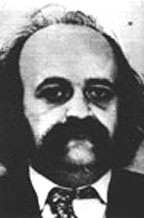
Although wholly unknown Ronald Hadley Stark might turn out to be one of the more influential personalities of american post war politics. He was the man who along with Stanley Owsley managed to supply the hippie-movement with millions of acid trips, changing the psychological make-up of left-wing politics forever.
As a matter of neccesity we will now be entering the world of conspiracy theories with this post. Why is that? Well, often when things are crucially important and information is scarce, three factors seem to re-inforce oneanother.
1. Individuals who are interested in the topic will give their imagination a free ride, and unrestrained by facts, tend to come up with the most entertaining and suspenseful explanations one could think of.
2. Individuals who do know what happened, but don´t want anybody else to find out, will often use mocked up conspiracy theories as a means of disinformation.
3. Information on the involvement of free and open societies will far outweigh the information on the operations of totalitarian states.
The second and third point areobviously very important with regard to the "big LSD conspiracy" flooding the internet. Everybody knows about CIAs MKULTRA program, because it was exposed publicly in hearings and newspapers. And because almost nothing is known about the experiments and applications developed behind the iron curtain, it might be tempting to speculate about CIA drugging up a whole generation with hallucinogens in a time of war.
But what about the old Cui Bono?
When you have very little information available, the natural thing to do is to look at the consequences of what you are investigating, and try to find a group of people, who one way or the other has drawn a benefit from it, and thus had an interest in bringing about the mysterious events. Then, after having found the Beneficiaries, you can move on to other things, such as means; opportunity; know-how etc. and try to profile the suspect based on his other activities...
Now let us consider the possibility of another intelligence agency, the KGB. Could they have drugged up a generation.
How does that fit in? Well, with regard to interest; opportunity; means; know-how and profile - it fits like a glove!
Now add the fact that the highest ranking officer to ever to defect from the soviet union, confirmed that this was indeed the case, even ran parts of the operation himself. Then contemplate the fact that cold war narcotics trafficking of the russians through proxies was not only extremely disruptive it was lucrative as well.
Or simply ask yourself - If you were a politician in the empire of evil and were able to make a lot of money without much risk, while at the same time defeating your worst enemy in a cruel and deadly war - would you do it?
Anyway, Ronald Hadley Stark is an important piece in this puzzle, often thought to be a CIA agent, but as the below post shows, seems more like a subversive agent working for the international socialists.
I took the liberty of copy-pasting this brilliant post on Ronald Hadley Stark from the interesting site Skilluminati Research below.
"...revolutions are not won by enlisting the masses. Revolution is a science for the few who are competent to practice it. It depends on correct organisation and above all, on communications." -- Robert Heinlen
11/30/11 -- The curse of doing research out here in Weirdoland is that the really fascinating people are nearly impossible to do research on. For instance, when you're covertly running the world's largest LSD manufacturing and smuggling operation for the CIA, you're not going to be doing interviews in Newsweek or publishing an autobiography. That's precisely the problem with Ronald Hadley Stark, who is one of the most insane characters in the history of LSD -- and that's really saying something, don't you think?This article has been updated considerably since I first published it. Stark's life story is beyond belief, so I think it's important to be meticulous. There are, no doubt, still hundreds of errors here.
For anyone unfamiliar with the tangle of political, scientific, cultural and covert forces behind spread of LSD, this article could get confusing. Ronald Stark is a central figure in David Black's book ACID: A Secret History of LSD,
 but the best overall introduction to this material would be Acid Dreams,
 by Lee & Shlain. It's short and very readable, laying out the overall history in clear terms. For more serious seekers, I highly recommend HP Albarelli's masterpiece, A Terrible Mistake,
 which is meticulously documented and considerably broader than mere LSD history.
The Super-Context
Stark had been working with US intelligence agencies for at least 9 years by the time of his most infamous moment, a legendary meeting with the "hippie mafia" drug syndicate called The Brotherhood of Eternal Love. (no joke.) They were looking for a new supplier and Stark kicked off the meeting by showing them a kilogram of liquid LSD -- for US readers, that's 2.2 pounds of acid. Needless to say, his resume was persuasive. He claimed to have a dedicated lab in France, but it's his political philosophy that really makes Stark such an interesting character:"He had a mission, he explained, to use LSD in order to facilitate the overthrow of the political systems of both the capitalist West and communist East by inducing altered states of consciousness in millions of people. Stark did not hide the fact that he was well connected in the world of covert politics."
The Brotherhood was sufficiently impressed to bring Ronald Stark into the fold, and what followed was the Golden Era of cheap, high-quality LSD. From 1969 through 1973, Stark and the Brotherhood dosed a generation and got away with it, too.
 According to a figure quoted by everyone and verified by nobody, Stark made 20 kilograms of LSD in his career. Hippie lore generally gives Owsley Stanley the crown of the Acid King, but by Stanley's own estimates, his total production was a half kilogram. That might not sound like much -- but it adds up to over 5 million hits of acid. You can see why the Army and Navy were so interested in this compound: it is unusually powerful as drug molecules go.
Although the LSD story is closely associated with the Sandoz pharmaceutical corporation in Switzerland, most of the CIA's supply was actually domestic. Since at least 1954, the Eli Lilly Company was working under secret contract to keep the various MKNAOMI and ARTICHOKE research projects stocked up with magic mindfuck juice. The figures on their total LSD output are classified.
David Black: "Before clinching the deal with the Brotherhood of Eternal Love, Stark had been making some contacts in England among the radical psychiatry movement of R.D. Laing and the Tavistock Institute."
Obviously this was a big money business, and organized crime involvement was inevitable. Since small batches of LSD have a literally exponential commercial profit margin, technical expertise was highly rewarded. Consider the case of Clyde Apperson, a specialist in quickly setting up a fully functional manufacturing lab just about anywhere. More importantly, he could take them down even faster. For set-up, Apperson would charge $100,000 in cash -- take downs were only $50,000. He was finally busted working in the infamous abandoned missile silo with William Leonard Pickard in 2000.
 Everyone's always getting busted, though. The history of LSD is full of incredibly intelligent men making highly stupid decisions. Yet through it all, from Operation Julie to the Sand-Scully case, Ronald Stark just kept on trucking. He was a calculating cameo artist: always on the scene, never holding the bag.
Until he suddenly was: "Whatever game Stark was playing took an abrupt turn in February 1975 when Italian police received an anonymous phone call about a man selling drugs in a hotel in Bologna. A few days later at the Grand Hotel Baglioni they arrested a suspect in possession of 4,600 kilos of marijuana, morphine, and cocaine. The suspect carried a British passport bearing the name Mr. Terrence W. Abbott. Italian investigators soon discovered that "Mr. Abbott" was actually Ronald Stark."-- Source: Acid Dreams,
pg. 213 Terrence W. Abbott was holding a genuine British passport, number 348489A, which was issued in 1973. The story of how he got it will never be told -- British intelligence refused to release his files. The FBI refused to share their files on him with the DEA's investigation, and the US State Department has actively interfered with many foreign attempts to extradite or prosecute Stark. The man led a charmed life.
"...the picture of Stark's activities began to broaden with the discovery of a vial of liquid and a cache of papers kept in a Rome bank deposit box. The vial was sent for forensic examination. The scientists reported back that they could not precisely identify the drug it contained. At best, they put it close to LSD. Perhaps it was the synthetic THC Stark had dreamt of creating; the papers included formulae for the synthesis. There were also plans for the bulk purchase of hemp seeds and calculations for shipments, investments and plant installation. Some of the papers went back to the Brotherhood days but they gave no details of his LSD operations after the Belgian episode. They did show that his range of interests in the drug world had expanded to include narcotics. There were details of the synthesis of cocaine." Source: The Brotherhood of Eternal Love
 Stark's time in Italy is the strangest and bloodiest chapter of his odd history. Although most accounts frame his 1975 arrest as a "bust," one commentator who does not is worth mentioning here: Phillip Willan. His view of Stark is shaped not by LSD folklore, but through earnest journalism and research into the history of political terrorism in Italy. The Ronald Stark that Willan presents is not a drug lord getting taken down, so much as an intelligence asset deliberately changing venues.
Willan: "Stark's arrest in Italy was prompted by a mysterious phone call to the police and he seems quite happy to go to prison, where his time was gainfully employed in winning the confidence of captured Red Brigades leaders, given that he turned down the opportunity of bail in August 1978."
Stark was no mere snitch, though. He was actively setting up infrastructure, teaching the principles of operational security and preaching the virtues of the "cell" structure. "He also provided them with a cryptographic system for coded radio communications," Willan says, although it should be assumed that Stark was also passing that system on to his secret employers. Prison records show that he met with Italian police and intelligence agents many times while he was networking there. It was in Italy that a large part of Ronald Stark's operation collapsed into the visible world. The facts that emerged are an education in covert warfare and intelligence operations.
Some Heavy Dudes
 "...his preferred to keep his range of contacts ignorant of each other's activities. Oftentimes he concealed the fact he was an American. His European associates were not privvy to his affairs in Africa, and those in Asia knew little about his work in the states. The brothers, for example, had no idea he was running a separate cocaine ring in the Bay Area." -- Acid Dreams, pg 250
Researching Roland Stark, I was reminded of people like Porter Goss, Henry Karl "Andijra" Puharich, or Barry Seal: it is unreal how much this guy got around. He stayed in close contact with the founders of "The Process Church of the Final Judgement," which is another hub in the Dark Network of occult history.
They began as a splinter group who broke ranks from Scientology, which meant they were waging spiritual war with L. Ron Hubbard from 1965 through 1974, which was a pretty bad year for "The Teacher," Robert DeGrimston. He was booted from his own cult and his wife divorced him on her journey to starting a successful chain of "Best Friends" animal shelters. (No joke.)
 All of which sounds way more lurid than it was. Stark was ultimately a drug dealer so beyond being Very Interesting, his link with the Process Church doesn't imply any shared philosophy...and doesn't exclude it, either. The oddball sociologist William Sims Bainbridge studied the group for months, and he didn't exactly make it sound like a blood magick sacrifice: "there was no violence and no indiscriminate sex, but I found a remarkably aesthetic and intelligent alternative to conventional religion." Then again, the Solar Temple was full of wealthy and sophisticated people who held refined parties and had very high-level conversations right up until the mass murder, mass suicide thing.
(For considerably more detail on the Process, refer to the Bainbridge essay Social Construction from Within: Satan's Process.)
 Timothy Leary was a perfect avatar for the Age of Horus: playful, brilliantly creative and blissfully unaware of the bad consequences he was unleashing. Although there is little evidence to tie Leary himself to the drug smuggling and merchandising activities of the Brotherhood, there is no question he quickly became the spiritual center of the group. For what it's worth, Leary himself downplayed their significance:
LEARY: "The whole concept of the Brotherhood of Eternal Love is like a bogeyman invented by the narcs. The brotherhood was about eight surfer kids from Southern California, Laguna Beach, who took the LSD, and they practiced the religion of the worship of nature, and they'd go into the mountains. But they were not bigshots at all. None of them ever drove anything better than a VW bus. They were just kind of in it for the spiritual thrill."
Maybe so -- but probably not. In September 1970, Leary escaped from prison in a complicated deal exposing just how serious the Brotherhood network had become. Money from Ronald Stark was paid to the Weather Underground, which is the precise point where the "hippie mafia" became connected to actual hippie terrorists. Leary himself wound up in Algeria under the (very) armed watch of Eldridge Cleaver, himself in exile. A year later, Leary and his wife were in Switzerland, living under the protection of the arms dealer Michel Hauchard. For a story about spiritual thrills, there's definitely a lot of guns involved here.
 At one point, though, maybe the Brotherhood really was just a group of hippies with a couple trunks full of weed. The Weather Underground were harmless student activists for awhile, too. Once Stark was brought into the Brotherhood, he quickly took change of the entire operation, establishing secure shipments and managing every aspect of their finances. "Stark warned them that buying real estate openly, as they had done, was much too risky -- but his lawyers could remedy the situation by hiding ownership in a maze of shell companies."
This is a repeated pattern in Stark's operations: he is always ready to create an organization where none exists. After Owsley got busted and the Brotherhood went international, many of the original bay area chemists got wise to what Stark was really doing. "We were definitely very gullible in believing the stuff he told us," as poor Tim Scully would later observe.
The Brotherhood got plugged into Stark's global underground very quickly: massive marijuana imports from the Middle East, shadow bank accounts in the Cayman Islands, and he was somehow micro-managing everything. Once he had flooded the West Coast with Afghan weed, Stark turned his attention to New York City, which was completely unprepared for the sheer quantity the Brotherhood supplied. From distribution to organizing street-level dealers, Stark was there, establishing Ordo Ab Chao is his own specific way.
 Skilluminati readers may already be familiar with Mr. Nice, the Welsh arms trader and Hashish entrepreneur who paved the pipeline that brought Afghanistan's finest exports into the hands of hippies and other connoisseurs all around the world. His real name is Howard Marks and his pioneering work in cultural exchange was the foundation for everything from the Cannabis Cup to Afghanistan's ongoing civil war, although of course neither was actually Howard's fault. Unlike Stark, he's made a modest living telling colorful and contrite stories of his drug dealing days. Part of the Mr. Nice gig, of course, is that he swears he's never used violence or trafficked in "hard drugs" -- which was probably an even bigger factor in his early retirement than getting busted by the DEA. Afghanistan, of course, got very heavy very quick and Mr. Nice was steamrolled out of the picture in short order.
Howard Marks was very much a hippie. Ronald Stark was something else altogether.
Giorgio Floridia
 Most of what's known about Ronald Stark today is through an Italian magistrate named Giorgio Floridia, who released Stark from Italian prison in 1979. After Stark had gotten himself caught in 1975, he busied himself trying to convince anyone and everyone that he was operating with the blessings of the United States government. Four years later, he finally managed to persuade Floridia, who cited "an impressive series of scrupulously enumerated proofs" that Stark had given him.
At his appeals trial Stark changed identities once again, this time passing himself off as "Khouri Ali," a radical Palestinian. In fluent Arabic he spelled out the details of his autobiography, explaining that he was part of an international terrorist organization headquartered in Lebanon, called "Group 14." Stark's appeal failed, and he was sent back to jail.Floridia also claims Stark worked for the Defense Department from 1960 on, and recieved paychecks from Fort Lee, in New Jersey. It is worth considering that Stark might have exaggerated his role and connections, and even fabricated evidence, in presenting his case to the magistrate who was in a position to free him. Either way, it worked. Stark was released on parole....and disappeared days later.
But Italian police took a renewed interest in his case after they captured Enrique Paghera, another terrorist leader who knew Stark. At the time of his arrest Paghera was holding a hand-drawn map of a PLO camp in Lebanon. The map, Paghera confessed, had come from Stark, who also provided a coded letter of introduction. The objective, according to Paghera, was to forge a link with a terrorist organization that was planning to attack embassies.
In terms of Floridia's motivation, it's worth considering the fate of the guy who came before him:
In June 1978 a Bologna magistrate, Graziano Gori, was assigned to investigate Stark and his astounding web of associates. A few weeks later, Gori was killed in a car wreck.That, of course, might be the most "impressive proof" of all.
Somehow Not the End
 Ronald Stark turned up in Holland in 1982. There's not a lot of published details, but it clearly involves 16 kilos of hasish and a Lebanese cover identity. He was busted en route to New York City. He got deported the next year and apparently died in custody -- because when Italy requested that he be extradited on terrorism charges, the US replied with a copy of Stark's death certificate.
(You guessed it -- "heart attack.")
His paper trail comes to an end here, although the reader can be forgiven for assuming his crusade continued covertly. There was certainly no retirement for a man like Stark. His mission was too important, too huge for a mere career.
 ...but then again, what was his mission, after all? Is it a mistake to place any stock in what he told the Brotherhood of Eternal Love? Perhaps not. Although Ronald Hadley Stark was many things to many people, the sole constant that emerges is Revolution. From the Weather Underground to the Red Brigades, from the PLO to the IRS, Stark was consistently moving in circles where the overthrow of government and the liberation of the people were central themes...circles that today would be considered "Terrorist." Certainly, Stark manipulated and lied to his contacts every step of the way, and it's safe to assume the speeches he gave to the Palestinians and Italians were much different from the picture he was painting in 1969 for the Brotherhood.
It's worth revisiting, though: "...in order to facilitate the overthrow of the political systems of both the capitalist West and communist East by inducing altered states of consciousness in millions of people." Now, Hadley's chosen network makes it pretty clear that he viewed automatic rifles and firebombs as equally valid tools for "inducing altered states of consciousness," and it's unlikely that a realist like Stark honestly believed that LSD was going amount to much more than a profitable business. Setting that aside, overthrowing both capitalism and communism sounds like an authentic statement of Stark's overall goals, or at least one that fits his sketchy and fast-moving modus operandi.
Stark was an infiltrator, creating back channels for communication between intelligence and police agencies and the underground movements that were trying to fight them. The fact he was so successful and so prolific is what makes him a remarkable character. Throughout his documented life, Stark is relentlessly working with, for and against dozens of competing players. He travels constantly, juggles multiple identities and stays actively involved in multiple conflicts simultaneously.Looking over his strange, tangled career, it's hard to avoid thinking that LSD was really not the point. The single biggest producer of raw LSD the world has ever known was not a True Believer, he was just passing through on his way to bigger and better things. His work for US intelligence agencies had less to do with blowing minds than establishing connections. Vast quantities of acid was perhaps more of a bona fide, a calling card to establish himself as a legitimate criminal figure.
Which brings us, finally, full circle.

A Harsh Mistress
In 1966, Putnam & Sons published a new novel from Robert Heinlein named The Moon is a Harsh Mistress. The plot concerns a worker's revolution on a Lunar colony, organized by a small group of people with considerable assistance from a self-aware supercomputer that controls the colony's infrastructure. Written in a distinctively abbreviated "Moonspeak," the book goes into remarkable detail about secure, secret communication networks. Stark was seldom without a copy and spoke highly of it around the world. Perhaps the closest we can ultimately get to unraveling his motives and beliefs is within the pages of a sci-fi story, rather than the life he left behind.It's impossible to write about the character of Ronald Stark without discussing the character of Professor Bernardo de la Paz. As the brains behind the Lunar revolution, the Professor has several extensive monologues about the design principles behind covert operations. "Revolution," the Prof says, "is an art I pursue, rather than a goal I expect to achieve."
The end of the novel is pure Chinatown. The revolution gets subverted like revolutions always do, and Heinlein was really writing a love song about The Frontier itself. Revolution is the flame that extinguishes itself, for simple and practical reasons: "Every new member made it that much more likely that you would be betrayed," as the Prof puts it.
"Organization must be no larger than necessary -- never recruit anyone merely because he wants to join. As to basic structure, a revolution starts as a conspiracy; therefore structure is small, secret and organized as to minimize damage by betrayal -- since there are always betrayals. One solution is the cell system and so far nothing better has been invented."
 The Professor goes on to propose a mandala of three-member cells, all reporting through a single Leader node back towards the center. This compartmentalized approach allows the founders to both monopolize information flow and insulate themselves against exposure. The concept is simple and effective, and it has been proven here in the real world for decades, from terrorist networks to intelligence agencies to evangelical Christians. It is staggering to think of how much Ronald Stark was connected to, assuming he rigorously pursued the Professor's blueprint, as Art for Art's sake. It is sobering to realize that the long, wide trail of covert history I've outlined here was just a couple of cells that got busted, part of a larger picture that is gone completely here in 2010.
His greatest achievements were the successful conspiracies, the completed operations that will never get traced back to his careful planning and constant hard work. There are too many huge gaps and unanswered questions to leave much doubt that Ronald Hadley Stark had a very impressive batting average. He was in a line of work where invisibility is the goal, and his true legacy is hiding behind headlines we will never understand, out here in the herd.
pg 77 "Correctly organized and properly timed it is a bloodless coup. Done clumsily or prematurely and the result is civil war, mob violence, purges, terror. I hope you will forgive me if I say that, up to now, it has been done clumsily."
Further Reading
Sorry, no LSD recipes here. Handy safety test: if you need to google the instructions, you're not qualified to perform them. Don't play with fire, kids. Be sure to check out the Cult of the Dead Cow's review of Acid: A New Secret History of LSD" -- full of further information on Stark.
The always-excellent Gary Lachman offers a sober and detailed take on The Process Church.
If you want to learn more about the Brotherhood of Eternal Love, that's good: you should. There's an outstanding book on the subject, predictably titled The Brotherhood of Eternal Love
 I recently read a new book on the subject, Orange Sunshine,
 which wasn't nearly as good.
Finally, for deep background on WTF Ronald Hadley Stark was doing in Italy during those mysterious final years of his life, Philip Willan's book is essential: "Puppetmasters: The Political Use of Terrorism in Italy
 ."
." Spread the Research:
Thanks to Jdamn!
Collection of interviews with vietnam veterans from 1985.
To be honest it simply breaks my heart to see these brave patriots left clueless, as to why they found themselves betrayed and scorned by the very countrymen who weren´t brave enough to go over and fight for freedom and democracy themselves. But how could they have known, that the enemy had conducted a highly succesful all-encompassing PSY-WAR on their homefront for 20 years? A multipronged campaign involving infiltration of all the relevant educational facilities, media and party political institutions; and a veritable drug-fest, putting a whole generation on halucinogens while agitating pacifism into their sleepy ears already busy following the weird pavlovian confusions called "psychedelic rock".
To set the tone, before delving into this time-window, let me quote some testimony from the Black Book of Communism, giving evidence to the fact that not only were concentration camps common in Northern Vietnam already in the 50s, they remained in place until around 1986. That means that all those years where the hippies were surfing the hedonist wave of "anti-war protests", hundreds of thousands of especially christian vietnamese were kept in concentration camps for being "bourgouis" or "collaborating" with the free world.
The fate bestowed upon these poor innocent people, captured often at random from every single village and tugged away in tiny dark rooms for years on end, if not tortured or starved to death - along with the socialist genocide in cambodia - will forever rest on the filthy conscience of the stupid politicised hedonists of the 70s "fighting for their right to party"
From the Black Book of Communism pp.573 A letter from the prisoners of vietnamese concentration camps 1977.


Thanks again to LibertyInOurTime for posting this amazing lecture. Please watch this all the way trough, as I consider it to be one of the most important speeches posted on this blog.
After watching this lecture I thought to myself - Is it just me, or does a certain conclusion slowly offer itself, with regard to many a mysterious cultural phenomena in the capitalist world, since the "Summer of Love"?
UPDATE: evidence of Czech military LSD testing:
Summarising some relevant facts...
1. In the 50s international socialists make extensive testing of LSD to be used in the war against the west.
2 In the 60s international socialists starts to give away LSD for free at universities. And by careful use of left-wing journalism, starts a drug-fest culminating in a yearly consumation of 22 million LSD doses in america alone.
3. Gigantic, highly politicised, musical events flooded in drugs and propaganda are organised by socialists, encouraging everybody to have sex and defy the draft for the vietnam war.
4. The highest ranking defector ever, the Chzech general Jan Sejna tells national security advisers all about this subversive attack on western democracy, and even ran parts of it himself prior to his defection.
5. Data from american policedepartments can read out all these initiatives by examining the supply-side of the drug trade.
6 An analysis of the political agendas popularised among the politicised hedonists confirms, that ALL proposed initiatives in effect weakened the west in its ability to confront the "empire of evil".
-Add to this innumerous other interesting coincidents, such as the weathermen busting none other than Tim Leary out of prison.
pluralitas non est ponenda sine necessitate!
An interesting example of just how deep this rabbit hole goes, is in my oppinion best illustrated by the tempting encouragement to "Make Love, not War". As any russian psychiatrist would tell you, a soldiers worst nightmare is coming home with all his honors, only to find his loved one in bed with one of the cowards, who stayed back home... Now, which "cultural initiations" would such a psychiatrist recommend to his superiours? Could it be something akin to "Free Love"?
And was it really random chance, that made "sex drugs and rock 'n' roll" coincide so beautifully with american soldiers going abroad? Take a look at the picture below. It is a "Purple Moebius" the official symbol of the "Free Love Movement".

Ring a bell?
One of the main objectives behind the extensive KGB drug-testing was to perfect different types of truthdrugs and interrogation techniques, enabling experts to obtain reliable information from POWs. Often the interrogator supplies the prisoners with drugs inducing a sense of extatic pleasure, followed by physical strain, and strategies of persuasion. This will in due time cause almost any person to give in, and do whatever "pusherman" says. Now, what most people don´t realise, is the fact that the chemical and psychological know-how developed within the framework of these extensive tests, is directly applicable to psychological warfare. The only difference being, that the objective isn´t the extraction of information from an individual, but the instillment of dis-information into an innocent mind.
The officially endorsed school of psychology behind the iron curtain, was not the confused babbling of the frankfurt school, or even lesser so the later generations of french "non-discourse". The soviet authorities preferred with good reason, the experimental behaviourism of Ivan Pavlov, and his brilliant theory of conditioned responses. Pavlov even wrote 400 pages on dis-information strategies on Lenins command and spent most of his later years studying experimentally induced neurosis. It is therefore only natural to assume, that pavlovian behaviourism would have shaped the strategic thinking behind the psycho-political warfare aswell. Now, what might military psychiatrist, trained in Pavlovian behaviourism and highly experienced in combinations of truth-drugging and interrogation techniques, recommend to his superiours, in order to enhance receptiveness towards socialist propaganda? I suppose the answer is rather straigh forward: "create an environment of stressing stimuli and extreme physical pleasure artificially, and embed our message herein". This way thoughtfulness is weakened and persuasion is motivated by itself, because the message is linked to the artificially induced pleasure. An individual repetetiously exposed to this "treatment" will accept the message because it has been linked with extreme pleasure and defend it like a loved one, if he feels it attacked by outsiders. Uhmm, Woodstock, anyone?
Following this train of thought one has to arrive at the nightmarish conclusion, that "Peace Love and Understanding" was little more than a skillfully hidden imperative: "Betray your country, betray your boyfriend, and pollute your mind, so as to never realise what you have done".
For people like myself, pondering the deranged irrationality of the left, this explanation should not be dismissed without careful contemplation.
Good and thourough Documentary on the origin of political correctness. As it turns out it is a revision of the marxist concept of false consciousness and has very real similarities with policies made by the communists in the eastern bloc in order to silence dissent.
The western variant originated in the "critical theory" of the Frankfurt School. Refusing to take any responsibility for their own beliefsystem and present their agenda in a direct and comprehensible manner,they found themselves content with igniting the conflicts within capitalist societies in order to weaken them. Promoting hedonism and making enemies of every thinkable grouping within the free world, they kept authorities comfortably busy on the homefront. Blacks and whites, husbands and wives, young and old, gay and straight etc. If gay-marriages were to become a majority preference one day, they would surely fight for the rights of the minority-group of individuals who want to marry their pets and criticise homosexuals for discriminating against people with a more polymorpheus sexuality than themselves.
In essence many of the moronic professors now presiding over all the big social "studies" departments at american and european universities are the wounded victims of this aspect of the cold war. Getting a helping hand by the active measures of the soviet union because they had a weakened sense of truth, unable to resist the careful attack on academia, led by the cultural marxists, disappointed by the revolutionary potential of the western working class
below is a lecture on the origins of political correctness
The Origins of Political Correctness
An Accuracy in Academia Address by Bill Lind
Variations of this speech have been delivered to various AIA conferences including the 2000 Consevative University at American University
Where does all this stuff that you’ve heard about this morning – the victim feminism, the gay rights movement, the invented statistics, the rewritten history, the lies, the demands, all the rest of it – where does it come from? For the first time in our history, Americans have to be fearful of what they say, of what they write, and of what they think. They have to be afraid of using the wrong word, a word denounced as offensive or insensitive, or racist, sexist, or homophobic.
We have seen other countries, particularly in this century, where this has been the case. And we have always regarded them with a mixture of pity, and to be truthful, some amusement, because it has struck us as so strange that people would allow a situation to develop where they would be afraid of what words they used. But we now have this situation in this country. We have it primarily on college campuses, but it is spreading throughout the whole society. Were does it come from? What is it?
We call it "Political Correctness." The name originated as something of a joke, literally in a comic strip, and we tend still to think of it as only half-serious. In fact, it’s deadly serious. It is the great disease of our century, the disease that has left tens of millions of people dead in Europe, in Russia, in China, indeed around the world. It is the disease of ideology. PC is not funny. PC is deadly serious.
If we look at it analytically, if we look at it historically, we quickly find out exactly what it is. Political Correctness is cultural Marxism. It is Marxism translated from economic into cultural terms. It is an effort that goes back not to the 1960s and the hippies and the peace movement, but back to World War I. If we compare the basic tenets of Political Correctness with classical Marxism the parallels are very obvious.
First of all, both are totalitarian ideologies. The totalitarian nature of Political Correctness is revealed nowhere more clearly than on college campuses, many of which at this point are small ivy covered North Koreas, where the student or faculty member who dares to cross any of the lines set up by the gender feminist or the homosexual-rights activists, or the local black or Hispanic group, or any of the other sainted "victims" groups that PC revolves around, quickly find themselves in judicial trouble. Within the small legal system of the college, they face formal charges – some star-chamber proceeding – and punishment. That is a little look into the future that Political Correctness intends for the nation as a whole.
Indeed, all ideologies are totalitarian because the essence of an ideology (I would note that conservatism correctly understood is not an ideology) is to take some philosophy and say on the basis of this philosophy certain things must be true – such as the whole of the history of our culture is the history of the oppression of women. Since reality contradicts that, reality must be forbidden. It must become forbidden to acknowledge the reality of our history. People must be forced to live a lie, and since people are naturally reluctant to live a lie, they naturally use their ears and eyes to look out and say, "Wait a minute. This isn’t true. I can see it isn’t true," the power of the state must be put behind the demand to live a lie. That is why ideology invariably creates a totalitarian state.
Second, the cultural Marxism of Political Correctness, like economic Marxism, has a single factor explanation of history. Economic Marxism says that all of history is determined by ownership of means of production. Cultural Marxism, or Political Correctness, says that all history is determined by power, by which groups defined in terms of race, sex, etc., have power over which other groups. Nothing else matters. All literature, indeed, is about that. Everything in the past is about that one thing.
Third, just as in classical economic Marxism certain groups, i.e. workers and peasants, are a priori good, and other groups, i.e., the bourgeoisie and capital owners, are evil. In the cultural Marxism of Political Correctness certain groups are good – feminist women, (only feminist women, non-feminist women are deemed not to exist) blacks, Hispanics, homosexuals. These groups are determined to be "victims," and therefore automatically good regardless of what any of them do. Similarly, white males are determined automatically to be evil, thereby becoming the equivalent of the bourgeoisie in economic Marxism.
Fourth, both economic and cultural Marxism rely on expropriation. When the classical Marxists, the communists, took over a country like Russia, they expropriated the bourgeoisie, they took away their property. Similarly, when the cultural Marxists take over a university campus, they expropriate through things like quotas for admissions. When a white student with superior qualifications is denied admittance to a college in favor of a black or Hispanic who isn’t as well qualified, the white student is expropriated. And indeed, affirmative action, in our whole society today, is a system of expropriation. White owned companies don’t get a contract because the contract is reserved for a company owned by, say, Hispanics or women. So expropriation is a principle tool for both forms of Marxism.
And finally, both have a method of analysis that automatically gives the answers they want. For the classical Marxist, it’s Marxist economics. For the cultural Marxist, it’s deconstruction. Deconstruction essentially takes any text, removes all meaning from it and re-inserts any meaning desired. So we find, for example, that all of Shakespeare is about the suppression of women, or the Bible is really about race and gender. All of these texts simply become grist for the mill, which proves that "all history is about which groups have power over which other groups." So the parallels are very evident between the classical Marxism that we’re familiar with in the old Soviet Union and the cultural Marxism that we see today as Political Correctness.
But the parallels are not accidents. The parallels did not come from nothing. The fact of the matter is that Political Correctness has a history, a history that is much longer than many people are aware of outside a small group of academics who have studied this. And the history goes back, as I said, to World War I, as do so many of the pathologies that are today bringing our society, and indeed our culture, down.
Marxist theory said that when the general European war came (as it did come in Europe in 1914), the working class throughout Europe would rise up and overthrow their governments – the bourgeois governments – because the workers had more in common with each other across the national boundaries than they had in common with the bourgeoisie and the ruling class in their own country. Well, 1914 came and it didn’t happen. Throughout Europe, workers rallied to their flag and happily marched off to fight each other. The Kaiser shook hands with the leaders of the Marxist Social Democratic Party in Germany and said there are no parties now, there are only Germans. And this happened in every country in Europe. So something was wrong.
Marxists knew by definition it couldn’t be the theory. In 1917, they finally got a Marxist coup in Russia and it looked like the theory was working, but it stalled again. It didn’t spread and when attempts were made to spread immediately after the war, with the Spartacist uprising in Berlin, with the Bela Kun government in Hungary, with the Munich Soviet, the workers didn’t support them.
So the Marxists’ had a problem. And two Marxist theorists went to work on it: Antonio Gramsci in Italy and Georg Lukacs in Hungary. Gramsci said the workers will never see their true class interests, as defined by Marxism, until they are freed from Western culture, and particularly from the Christian religion – that they are blinded by culture and religion to their true class interests. Lukacs, who was considered the most brilliant Marxist theorist since Marx himself, said in 1919, "Who will save us from Western Civilization?" He also theorized that the great obstacle to the creation of a Marxist paradise was the culture: Western civilization itself.
Lukacs gets a chance to put his ideas into practice, because when the home grown Bolshevik Bela Kun government is established in Hungary in 1919, he becomes deputy commissar for culture, and the first thing he did was introduce sex education into the Hungarian schools. This ensured that the workers would not support the Bela Kun government, because the Hungarian people looked at this aghast, workers as well as everyone else. But he had already made the connection that today many of us are still surprised by, that we would consider the "latest thing."
In 1923 in Germany, a think-tank is established that takes on the role of translating Marxism from economic into cultural terms, that creates Political Correctness as we know it today, and essentially it has created the basis for it by the end of the 1930s. This comes about because the very wealthy young son of a millionaire German trader by the name of Felix Weil has become a Marxist and has lots of money to spend. He is disturbed by the divisions among the Marxists, so he sponsors something called the First Marxist Work Week, where he brings Lukacs and many of the key German thinkers together for a week, working on the differences of Marxism.
And he says, "What we need is a think-tank." Washington is full of think tanks and we think of them as very modern. In fact they go back quite a ways. He endows an institute, associated with Frankfurt University, established in 1923, that was originally supposed to be known as the Institute for Marxism. But the people behind it decided at the beginning that it was not to their advantage to be openly identified as Marxist. The last thing Political Correctness wants is for people to figure out it’s a form of Marxism. So instead they decide to name it the Institute for Social Research.
Weil is very clear about his goals. In 1971, he wrote to Martin Jay the author of a principle book on the Frankfurt School, as the Institute for Social Research soon becomes known informally, and he said, "I wanted the institute to become known, perhaps famous, due to its contributions to Marxism." Well, he was successful. The first director of the Institute, Carl Grunberg, an Austrian economist, concluded his opening address, according to Martin Jay, "by clearly stating his personal allegiance to Marxism as a scientific methodology." Marxism, he said, would be the ruling principle at the Institute, and that never changed.
The initial work at the Institute was rather conventional, but in 1930 it acquired a new director named Max Horkheimer, and Horkheimer’s views were very different. He was very much a Marxist renegade. The people who create and form the Frankfurt School are renegade Marxists. They’re still very much Marxist in their thinking, but they’re effectively run out of the party. Moscow looks at what they are doing and says, "Hey, this isn’t us, and we’re not going to bless this."
Horkheimer’s initial heresy is that he is very interested in Freud, and the key to making the translation of Marxism from economic into cultural terms is essentially that he combined it with Freudism. Again, Martin Jay writes, "If it can be said that in the early years of its history, the Institute concerned itself primarily with an analysis of bourgeois society’s socio-economic sub-structure," – and I point out that Jay is very sympathetic to the Frankfurt School, I’m not reading from a critic here – "in the years after 1930 its primary interests lay in its cultural superstructure. Indeed the traditional Marxist formula regarding the relationship between the two was brought into question by Critical Theory."
The stuff we’ve been hearing about this morning – the radical feminism, the women’s studies departments, the gay studies departments, the black studies departments – all these things are branches of Critical Theory. What the Frankfurt School essentially does is draw on both Marx and Freud in the 1930s to create this theory called Critical Theory. The term is ingenious because you’re tempted to ask, "What is the theory?" The theory is to criticize. The theory is that the way to bring down Western culture and the capitalist order is not to lay down an alternative. They explicitly refuse to do that. They say it can’t be done, that we can’t imagine what a free society would look like (their definition of a free society). As long as we’re living under repression – the repression of a capitalistic economic order which creates (in their theory) the Freudian condition, the conditions that Freud describes in individuals of repression – we can’t even imagine it. What Critical Theory is about is simply criticizing. It calls for the most destructive criticism possible, in every possible way, designed to bring the current order down. And, of course, when we hear from the feminists that the whole of society is just out to get women and so on, that kind of criticism is a derivative of Critical Theory. It is all coming from the 1930s, not the 1960s.
Other key members who join up around this time are Theodore Adorno, and, most importantly, Erich Fromm and Herbert Marcuse. Fromm and Marcuse introduce an element which is central to Political Correctness, and that’s the sexual element. And particularly Marcuse, who in his own writings calls for a society of "polymorphous perversity," that is his definition of the future of the world that they want to create. Marcuse in particular by the 1930s is writing some very extreme stuff on the need for sexual liberation, but this runs through the whole Institute. So do most of the themes we see in Political Correctness, again in the early 30s. In Fromm’s view, masculinity and femininity were not reflections of ‘essential’ sexual differences, as the Romantics had thought. They were derived instead from differences in life functions, which were in part socially determined." Sex is a construct; sexual differences are a construct.
Another example is the emphasis we now see on environmentalism. "Materialism as far back as Hobbes had led to a manipulative dominating attitude toward nature." That was Horkhemier writing in 1933 in Materialismus und Moral. "The theme of man’s domination of nature," according to Jay, " was to become a central concern of the Frankfurt School in subsequent years." "Horkheimer’s antagonism to the fetishization of labor, (here’s were they’re obviously departing from Marxist orthodoxy) expressed another dimension of his materialism, the demand for human, sensual happiness." In one of his most trenchant essays, Egoism and the Movement for Emancipation, written in 1936, Horkeimer "discussed the hostility to personal gratification inherent in bourgeois culture." And he specifically referred to the Marquis de Sade, favorably, for his "protest…against asceticism in the name of a higher morality."
How does all of this stuff flood in here? How does it flood into our universities, and indeed into our lives today? The members of the Frankfurt School are Marxist, they are also, to a man, Jewish. In 1933 the Nazis came to power in Germany, and not surprisingly they shut down the Institute for Social Research. And its members fled. They fled to New York City, and the Institute was reestablished there in 1933 with help from Columbia University. And the members of the Institute, gradually through the 1930s, though many of them remained writing in German, shift their focus from Critical Theory about German society, destructive criticism about every aspect of that society, to Critical Theory directed toward American society. There is another very important transition when the war comes. Some of them go to work for the government, including Herbert Marcuse, who became a key figure in the OSS (the predecessor to the CIA), and some, including Horkheimer and Adorno, move to Hollywood.
These origins of Political Correctness would probably not mean too much to us today except for two subsequent events. The first was the student rebellion in the mid-1960s, which was driven largely by resistance to the draft and the Vietnam War. But the student rebels needed theory of some sort. They couldn’t just get out there and say, "Hell no we won’t go," they had to have some theoretical explanation behind it. Very few of them were interested in wading through Das Kapital. Classical, economic Marxism is not light, and most of the radicals of the 60s were not deep. Fortunately for them, and unfortunately for our country today, and not just in the university, Herbert Marcuse remained in America when the Frankfurt School relocated back to Frankfurt after the war. And whereas Mr. Adorno in Germany is appalled by the student rebellion when it breaks out there – when the student rebels come into Adorno’s classroom, he calls the police and has them arrested – Herbert Marcuse, who remained here, saw the 60s student rebellion as the great chance. He saw the opportunity to take the work of the Frankfurt School and make it the theory of the New Left in the United States.
One of Marcuse’s books was the key book. It virtually became the bible of the SDS and the student rebels of the 60s. That book was Eros and Civilization. Marcuse argues that under a capitalistic order (he downplays the Marxism very strongly here, it is subtitled, A Philosophical Inquiry into Freud, but the framework is Marxist), repression is the essence of that order and that gives us the person Freud describes – the person with all the hang-ups, the neuroses, because his sexual instincts are repressed. We can envision a future, if we can only destroy this existing oppressive order, in which we liberate eros, we liberate libido, in which we have a world of "polymorphous perversity," in which you can "do you own thing." And by the way, in that world there will no longer be work, only play. What a wonderful message for the radicals of the mid-60s! They’re students, they’re baby-boomers, and they’ve grown up never having to worry about anything except eventually having to get a job. And here is a guy writing in a way they can easily follow. He doesn’t require them to read a lot of heavy Marxism and tells them everything they want to hear which is essentially, "Do your own thing," "If it feels good do it," and "You never have to go to work." By the way, Marcuse is also the man who creates the phrase, "Make love, not war." Coming back to the situation people face on campus, Marcuse defines "liberating tolerance" as intolerance for anything coming from the Right and tolerance for anything coming from the Left. Marcuse joined the Frankfurt School, in 1932 (if I remember right). So, all of this goes back to the 1930s.
In conclusion, America today is in the throws of the greatest and direst transformation in its history. We are becoming an ideological state, a country with an official state ideology enforced by the power of the state. In "hate crimes" we now have people serving jail sentences for political thoughts. And the Congress is now moving to expand that category ever further. Affirmative action is part of it. The terror against anyone who dissents from Political Correctness on campus is part of it. It’s exactly what we have seen happen in Russia, in Germany, in Italy, in China, and now it’s coming here. And we don’t recognize it because we call it Political Correctness and laugh it off. My message today is that it’s not funny, it’s here, it’s growing and it will eventually destroy, as it seeks to destroy, everything that we have ever defined as our freedom and our culture.
Gisele Bundchen wears him on the runway, Johnny Depp wears him around his neck, and Benicio Del Toro becomes him in the new, highly acclaimed, two-part epic film from Steven Soderbergh, Che. Ernesto "Che" Guevara, the revolutionary who helped found communist Cuba, is the celebrity that celebrities adore. And be it Madonna, Rage Against the Machine, or Jay-Z, musicians really dig Che.
It’s something that baffles Cuban jazz legend Paquito D’Rivera. “Che hated artists, so how is it possible that artists still today support the image of Che Guevara?” Turns out the rebellious icon that emblazons countless T-shirts actually enforced aesthetic and political conformity. D’Rivera explains that Che and other Cuban authorities sought to ban rock and roll and jazz.
“Che was an inspiration for me,” D’Rivera tells reason.tv. “I thought I have to get out of this island as soon as I can, because I am in the wrong place at the wrong time!” D’Rivera did escape Cuba, and so far he’s won nine Grammy awards playing the kind of music Che tried to silence. But D’Rivera says Che’s crimes didn’t end with censorship. “He ordered the execution of many people with no trial.” Che served as Castro’s chief executioner, presiding over the infamous La Cabana prison. D’Rivera says Che’s policy of killing innocents earned him the nickname—the Butcher of La Cabana.
“We’re rightly horrified by fascist murderers like Adolph Hitler,” says reason.tv’s Nick Gillespie. “Why aren’t we also horrified by communist killers?” Certainly, Che’s body count isn’t anywhere near Hitler’s. But what about someone Che idolized, someone whom he might have liked to wear on his chest?
“Che, Castro, all the communist regimes idolized only one thing that Mao personifies—violence.” Kai Chen grew up in China under the reign of Mao Zedong. Although he won gold medals for China’s national basketball team, Chen’s was far from the celebrity life of an NBA star. Says Chen, “You have no right to talk, and you have no right to think.”
The punishment for questioning Mao’s authority was often death. The Black Book of Communism estimates that Mao is responsible for the deaths of 65 million people—a figure that dwarfs even Hitler’s body count. “Mao is a murderer,” says Chen. “The biggest mass murderer in human history.”
And yet, like Che, Mao’s image is becoming an increasingly popular way to move merchandise. You can buy Mao t-shirts, mugs, caps—you name it. Near Chen’s Los Angeles home there’s even a restaurant called Mao’s Kitchen. “Can you imagine a restaurant called Hitler’s Kitchen?” asks Gillespie.
Neither D’Rivera nor Chen understands why communist killers are considered Chic, but each finds his own way to have the last laugh on these anti-capitalist icons.
"Killer Chic" is written and produced by Ted Balaker. Director of Photography is Alex Manning.