
This is a good day here at Kitman TV. The Drugs and Disinfo series, that has grown considerably over the years, has now found a welcomed addition, in a symposium over at Frontpage Magazine, devoted specifically to this issue. It has some great contributions from both Joseph Douglass,who initially sparked my interest in this topic and Jeff Nyquist from the Strategic Crisis Center. I would like to thank Jamie Glazov for letting me participate, it was a pleeasure to be able to contribute to the exchange.

Symposium: Sex, Drugs and Psychological Warfare
In this special edition of Frontpage symposium, we have gather a distinguished panel to discuss how drugs have been used as a weapon of psycho-chemical warfare by our enemies. What have been the historical ramifications of the flooding of the free world with acid, heroin, and hashish from enemy territory, especially since the late 60s?or continue below.
Remarkably little research has been done on Cold War drug-supply, even though the communists clearly stated their intent on poisoning Western youth with drugs.
Joining us today are some of the people who have looked into this subject more closely. Towards the end of the talk, we hope to be able to draw some parallels with the current threat of Islamic Jihad:
Our guests are:
Frank Kitman, a blogger and independent researcher who specializes in how America’s enemies have used drugs as a weapon against us.
J. R. Nyquist, the president of the Strategic Crisis Center, Inc. (StrategicCrisis.com). He writes a column on global strategic issues for Financial Sense Online.
and
Dr. Joseph Douglass, among the first defense analysts to identify the Soviet intelligence operation to move narcotic drugs into the “enemy’s camp” to undermine the youth and culture. His first articles appeared in 1987 and 1988 and his book, Red Cocaine, in 1991. He was also the first to write about the development and covert use of psycho-active drugs by their intelligence services in covert operations to influence thinking and behavior in the Medical Sentinel journal. He has also written several books on Soviet nuclear strategy, decision making, on the Soviet practice of arms control violations, and on the missing American POW/MIAs from WWII, the Korean War, Vietnam War, and Cold War.
FP: Frank Kitman, J. R. Nyquist and Dr. Joseph Douglass, welcome to Frontpage Symposium.
Dr. Douglass, let’s begin with you. What is the best way for us to begin this discussion?
Perhaps you can enlighten us on some of the evidence that has linked communist activity with the massive increase in drug-supply in the United States — especially following U.S. entrance into the Vietnam war?
Douglass: Thank you Jamie.
To work our way into the Vietnam War, I would look first at the late 1940s following WWII. Because of constraints on shipping during the war and efforts of the US Narcotics Bureau before the war to bring the use of opium and heroin under control in the United States, the use of “illegal drugs” after WWII had dropped to its lowest level since the early 1900s. The stats on over dose of heroin in NYC had dropped to zero in 1948 as those on first use of heroin in San Francisco was close to that also. This all changed in 1949 when there was an abrupt rise in the use of illegal drugs. The same was true in Japan. US intelligence and Japanese intelligence independently determined that the rise in both countries was due to a new flow of drugs out of the new Communist China. This might be viewed as the opening of today’s psychochemical war using drugs.
The first book to report on this was The Traffic in Narcotics by the legendary Harry J. Anslinger. It was published in 1952 right on the heels of a USG report submitted to the United Nations on the increase in international narcotics trafficking. Two quite substantial books that added considerable detail to the new “Chinese communist drug offensive” were Psycho-Chemical Warfare by A.H. Stanton Candlin and The Peking Bomb by Gerd Hamburger in 1973 and 1975, respectively. Both described the new drug offensive with maps on poppy fields, organization and soforth. My information from a high communist source later confirmed this message and the deliberate use by the top Chinese leaders of narcotics as a weapon in a covert war against the United States and Japan.
The Chinese expanded this practice during the Korean War in 1951-1953. They targeted their trafficking specifically against the US military forces engaged in the Korean War, both those in Korea and those stationed in nearby bases, such as Japan and Okinawa. This was an especially important beginning of the use of psychochemical drugs as a weapon in war. This practice gained little attention in the West at the time, but it had a significant effect in damaging the readiness of US forces, especially in logistics units. Additionally, it proved the effectiveness of the tactic that would be greatly expanded in the Vietnam War... You can read the the whole symposium at Frontpage Magazine
Sex Drugs and Psychological Warfare
Decision-Making in Communist Countries: An Inside View (Foreign policy report)

We Will Bury You


(Note: This is a repost - Luckily youtube decided to enable an older youtube channel of mine for long-form uploads. I will therefore be moving a lot of material found on lesser known platforms onto that channel. You can follow the uploads by subscribing to this second channel here - The main Youtube channel is still to be found here)
Horrifying lectures by Joseph Douglass on the strategic thinking about biological/chemical and Pharmaceutical warfare behind the iron curtain.Doctors for Disaster Preparedness 22nd Annual Meeting June 25-27, 2004 San Diego, CA.
If from a United States defense standpoint, when concerned about chemical and biological warfare - Which is more important: Our iew of what these agents can do, or the russian view? I would submit to you, that what we think is rather irrelevant. And what is important is what the russians think. - Unfortunately this is not the case. The view of the United States when it comes to chemical and biological warfare is very rarely shaped by considerations of the threat. More often than not it is the result of mere imaging and the application of what I would like to call self-centered arrogance
Joseph Douglass second lecture on the weaponization of psychoactive drugs by the soviet bloc. It focusses on the key question, which is hardly ever asked, namely: what kind of knowledge and applications were actually developed through the extensive military testing of various psycho-active substances.
Dr. Douglass, a defense analyst, is the author of The Soviet Theater Nuclear Offensive and other books.
I went through the trouble of assembling a searchable pdf from this government report, prepared at the request of the United States House of Representatives. It deals extensively with what is known about the psychological war waged on the free world by the soviet union under the banner of "Active Measures", but concentrates on the "post cold war" era 1988-91.
It categorises the different kinds of operations into black white and grey, true and false, and conciliatory, derogatory and alarmist.
Alarmist disinfomation is a particularly interesting sub-genre, because the propagator cannot be dismissed by facts, atleast for quiete a few years. The global warming racket is without a doubt the best alarmist disinfo campign ever waged on the free world by the international left.
I believe many people underestimate the importance of these "active measures" and the overall destructive goals of the International Information Department, who conducted most of the operations. The reason for this is probably that the true scale of it is not appreciated, because people tend to forget that all the hard work of intelligence gathering had already been done by the KGB as such, and was then simply fed to the international department, where the informatioon was skillfully streamlined into slogans and "arguments" to gain strategic advantages. Imagine the boost any news outlet would gain, if it were fed all needed information directly from the CIA.
Surely, this meant an immense advantage, and enabled them to constantly provide new "stories" with sufficient evidence, to the anti-western leftist journalists, who then made headlines and refused to disclose their "sources".
This has been going on for so long now, that selfcriticism seem to have become the norm in most news media.
The Soviet Communist Party created what was, in all likelihood, the most formidableSoviet Active Measures in the "Post-Cold War" Era 1988-1991
political influence machine in the modern world. Although the Soviets had the
disadvantage of "selling" an enormously unpopular "product," they evolved a great deal
of manipulative and deceptive techniques to try to compensate for this disadvantage. A
close examination of how they sought to influence foreign publics and governments by
orchestrating and spreading carefully selected information, disinformation, and a variety
of crude, sophisticated, derogatory, conciliatory, and alarmist arguments and slogans
contains important lessons for the future in understanding how other totalitarian and
extremist regimes conduct active measures, and how some groups and states within the
Commonwealth of Independent States continue to try to achieve political influence using
these methods.
The 1982 seminal paper by Jeffrey G. on the use of hippies as a fifth column of agitated pacifist traitors during the cold war. This is required reading for anyone interested in the causes behind the selfdestructive nature of the western left since 1968.
Highly recommended!
Moscow and the Peace Offensive
Horrifying lecture by Joseph Douglass on the strategic thinking about biological and chemical warfare behind the iron curtain.
If from a United States defense standpoint, when concerned about chemical and biological warfare - Which is more important: Our iew of what these agents can do, or the russian view? I would submit to you, that what we think is rather irrelevant. And what is important is what the russians think. - Unfortunately this is not the case. The view of the United States when it comes to chemical and biological warfare is very rarely shaped by considerations of the threat. More often than not it is the result of mere imaging and the application of what I would like to call self-centered arrogance
Thanks again to Kabud for digging out this interesting document containing further confirmation of the use of psycho-active substances as a means of warfare against the free world from behind the iron curtain. It also mentions Jan Sejnas People´s Friendship program, which is most interesting for our purposes, namely a deeper understanding of why the left went mad.
Thanks to Zetomes for the upload
"Drugs" as Weapons
Truely disturbing lecture on the weaponization of psychoactive drugs by the soviet bloc. It focusses on the key question, which is hardly ever asked, namely: what kind of knowledge and applications were actually developed through the extensive military testing of various psycho-active substances.
Dr. Douglass, a defense analyst, is the author of The Soviet Theater Nuclear Offensive and other books. Doctors for Disaster Preparedness 22nd Annual Meeting June 25-27, 2004 San Diego, CA.
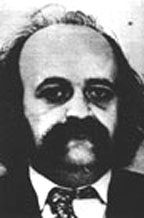
Although wholly unknown Ronald Hadley Stark might turn out to be one of the more influential personalities of american post war politics. He was the man who along with Stanley Owsley managed to supply the hippie-movement with millions of acid trips, changing the psychological make-up of left-wing politics forever.
As a matter of neccesity we will now be entering the world of conspiracy theories with this post. Why is that? Well, often when things are crucially important and information is scarce, three factors seem to re-inforce oneanother.
1. Individuals who are interested in the topic will give their imagination a free ride, and unrestrained by facts, tend to come up with the most entertaining and suspenseful explanations one could think of.
2. Individuals who do know what happened, but don´t want anybody else to find out, will often use mocked up conspiracy theories as a means of disinformation.
3. Information on the involvement of free and open societies will far outweigh the information on the operations of totalitarian states.
The second and third point areobviously very important with regard to the "big LSD conspiracy" flooding the internet. Everybody knows about CIAs MKULTRA program, because it was exposed publicly in hearings and newspapers. And because almost nothing is known about the experiments and applications developed behind the iron curtain, it might be tempting to speculate about CIA drugging up a whole generation with hallucinogens in a time of war.
But what about the old Cui Bono?
When you have very little information available, the natural thing to do is to look at the consequences of what you are investigating, and try to find a group of people, who one way or the other has drawn a benefit from it, and thus had an interest in bringing about the mysterious events. Then, after having found the Beneficiaries, you can move on to other things, such as means; opportunity; know-how etc. and try to profile the suspect based on his other activities...
Now let us consider the possibility of another intelligence agency, the KGB. Could they have drugged up a generation.
How does that fit in? Well, with regard to interest; opportunity; means; know-how and profile - it fits like a glove!
Now add the fact that the highest ranking officer to ever to defect from the soviet union, confirmed that this was indeed the case, even ran parts of the operation himself. Then contemplate the fact that cold war narcotics trafficking of the russians through proxies was not only extremely disruptive it was lucrative as well.
Or simply ask yourself - If you were a politician in the empire of evil and were able to make a lot of money without much risk, while at the same time defeating your worst enemy in a cruel and deadly war - would you do it?
Anyway, Ronald Hadley Stark is an important piece in this puzzle, often thought to be a CIA agent, but as the below post shows, seems more like a subversive agent working for the international socialists.
I took the liberty of copy-pasting this brilliant post on Ronald Hadley Stark from the interesting site Skilluminati Research below.
"...revolutions are not won by enlisting the masses. Revolution is a science for the few who are competent to practice it. It depends on correct organisation and above all, on communications." -- Robert Heinlen
 11/30/11 -- The curse of doing research out here in Weirdoland is that the really fascinating people are nearly impossible to do research on. For instance, when you're covertly running the world's largest LSD manufacturing and smuggling operation for the CIA, you're not going to be doing interviews in Newsweek or publishing an autobiography. That's precisely the problem with Ronald Hadley Stark, who is one of the most insane characters in the history of LSD -- and that's really saying something, don't you think?
This article has been updated considerably since I first published it. Stark's life story is beyond belief, so I think it's important to be meticulous. There are, no doubt, still hundreds of errors here.
For anyone unfamiliar with the tangle of political, scientific, cultural and covert forces behind spread of LSD, this article could get confusing. Ronald Stark is a central figure in David Black's book ACID: A Secret History of LSD,
 but the best overall introduction to this material would be Acid Dreams,
 by Lee & Shlain. It's short and very readable, laying out the overall history in clear terms. For more serious seekers, I highly recommend HP Albarelli's masterpiece, A Terrible Mistake,
 which is meticulously documented and considerably broader than mere LSD history.
The Super-Context
Stark had been working with US intelligence agencies for at least 9 years by the time of his most infamous moment, a legendary meeting with the "hippie mafia" drug syndicate called The Brotherhood of Eternal Love. (no joke.) They were looking for a new supplier and Stark kicked off the meeting by showing them a kilogram of liquid LSD -- for US readers, that's 2.2 pounds of acid. Needless to say, his resume was persuasive. He claimed to have a dedicated lab in France, but it's his political philosophy that really makes Stark such an interesting character:"He had a mission, he explained, to use LSD in order to facilitate the overthrow of the political systems of both the capitalist West and communist East by inducing altered states of consciousness in millions of people. Stark did not hide the fact that he was well connected in the world of covert politics."
The Brotherhood was sufficiently impressed to bring Ronald Stark into the fold, and what followed was the Golden Era of cheap, high-quality LSD. From 1969 through 1973, Stark and the Brotherhood dosed a generation and got away with it, too.
 According to a figure quoted by everyone and verified by nobody, Stark made 20 kilograms of LSD in his career. Hippie lore generally gives Owsley Stanley the crown of the Acid King, but by Stanley's own estimates, his total production was a half kilogram. That might not sound like much -- but it adds up to over 5 million hits of acid. You can see why the Army and Navy were so interested in this compound: it is unusually powerful as drug molecules go.
Although the LSD story is closely associated with the Sandoz pharmaceutical corporation in Switzerland, most of the CIA's supply was actually domestic. Since at least 1954, the Eli Lilly Company was working under secret contract to keep the various MKNAOMI and ARTICHOKE research projects stocked up with magic mindfuck juice. The figures on their total LSD output are classified.
David Black: "Before clinching the deal with the Brotherhood of Eternal Love, Stark had been making some contacts in England among the radical psychiatry movement of R.D. Laing and the Tavistock Institute."
Obviously this was a big money business, and organized crime involvement was inevitable. Since small batches of LSD have a literally exponential commercial profit margin, technical expertise was highly rewarded. Consider the case of Clyde Apperson, a specialist in quickly setting up a fully functional manufacturing lab just about anywhere. More importantly, he could take them down even faster. For set-up, Apperson would charge $100,000 in cash -- take downs were only $50,000. He was finally busted working in the infamous abandoned missile silo with William Leonard Pickard in 2000.
 Everyone's always getting busted, though. The history of LSD is full of incredibly intelligent men making highly stupid decisions. Yet through it all, from Operation Julie to the Sand-Scully case, Ronald Stark just kept on trucking. He was a calculating cameo artist: always on the scene, never holding the bag.
Until he suddenly was: "Whatever game Stark was playing took an abrupt turn in February 1975 when Italian police received an anonymous phone call about a man selling drugs in a hotel in Bologna. A few days later at the Grand Hotel Baglioni they arrested a suspect in possession of 4,600 kilos of marijuana, morphine, and cocaine. The suspect carried a British passport bearing the name Mr. Terrence W. Abbott. Italian investigators soon discovered that "Mr. Abbott" was actually Ronald Stark."-- Source: Acid Dreams,
pg. 213 Terrence W. Abbott was holding a genuine British passport, number 348489A, which was issued in 1973. The story of how he got it will never be told -- British intelligence refused to release his files. The FBI refused to share their files on him with the DEA's investigation, and the US State Department has actively interfered with many foreign attempts to extradite or prosecute Stark. The man led a charmed life.
"...the picture of Stark's activities began to broaden with the discovery of a vial of liquid and a cache of papers kept in a Rome bank deposit box. The vial was sent for forensic examination. The scientists reported back that they could not precisely identify the drug it contained. At best, they put it close to LSD. Perhaps it was the synthetic THC Stark had dreamt of creating; the papers included formulae for the synthesis. There were also plans for the bulk purchase of hemp seeds and calculations for shipments, investments and plant installation. Some of the papers went back to the Brotherhood days but they gave no details of his LSD operations after the Belgian episode. They did show that his range of interests in the drug world had expanded to include narcotics. There were details of the synthesis of cocaine." Source: The Brotherhood of Eternal Love
 Stark's time in Italy is the strangest and bloodiest chapter of his odd history. Although most accounts frame his 1975 arrest as a "bust," one commentator who does not is worth mentioning here: Phillip Willan. His view of Stark is shaped not by LSD folklore, but through earnest journalism and research into the history of political terrorism in Italy. The Ronald Stark that Willan presents is not a drug lord getting taken down, so much as an intelligence asset deliberately changing venues.
Willan: "Stark's arrest in Italy was prompted by a mysterious phone call to the police and he seems quite happy to go to prison, where his time was gainfully employed in winning the confidence of captured Red Brigades leaders, given that he turned down the opportunity of bail in August 1978."
Stark was no mere snitch, though. He was actively setting up infrastructure, teaching the principles of operational security and preaching the virtues of the "cell" structure. "He also provided them with a cryptographic system for coded radio communications," Willan says, although it should be assumed that Stark was also passing that system on to his secret employers. Prison records show that he met with Italian police and intelligence agents many times while he was networking there. It was in Italy that a large part of Ronald Stark's operation collapsed into the visible world. The facts that emerged are an education in covert warfare and intelligence operations.
Some Heavy Dudes
 "...his preferred to keep his range of contacts ignorant of each other's activities. Oftentimes he concealed the fact he was an American. His European associates were not privvy to his affairs in Africa, and those in Asia knew little about his work in the states. The brothers, for example, had no idea he was running a separate cocaine ring in the Bay Area." -- Acid Dreams, pg 250
Researching Roland Stark, I was reminded of people like Porter Goss, Henry Karl "Andijra" Puharich, or Barry Seal: it is unreal how much this guy got around. He stayed in close contact with the founders of "The Process Church of the Final Judgement," which is another hub in the Dark Network of occult history.
They began as a splinter group who broke ranks from Scientology, which meant they were waging spiritual war with L. Ron Hubbard from 1965 through 1974, which was a pretty bad year for "The Teacher," Robert DeGrimston. He was booted from his own cult and his wife divorced him on her journey to starting a successful chain of "Best Friends" animal shelters. (No joke.)
 All of which sounds way more lurid than it was. Stark was ultimately a drug dealer so beyond being Very Interesting, his link with the Process Church doesn't imply any shared philosophy...and doesn't exclude it, either. The oddball sociologist William Sims Bainbridge studied the group for months, and he didn't exactly make it sound like a blood magick sacrifice: "there was no violence and no indiscriminate sex, but I found a remarkably aesthetic and intelligent alternative to conventional religion." Then again, the Solar Temple was full of wealthy and sophisticated people who held refined parties and had very high-level conversations right up until the mass murder, mass suicide thing.
(For considerably more detail on the Process, refer to the Bainbridge essay Social Construction from Within: Satan's Process.)
 Timothy Leary was a perfect avatar for the Age of Horus: playful, brilliantly creative and blissfully unaware of the bad consequences he was unleashing. Although there is little evidence to tie Leary himself to the drug smuggling and merchandising activities of the Brotherhood, there is no question he quickly became the spiritual center of the group. For what it's worth, Leary himself downplayed their significance:
LEARY: "The whole concept of the Brotherhood of Eternal Love is like a bogeyman invented by the narcs. The brotherhood was about eight surfer kids from Southern California, Laguna Beach, who took the LSD, and they practiced the religion of the worship of nature, and they'd go into the mountains. But they were not bigshots at all. None of them ever drove anything better than a VW bus. They were just kind of in it for the spiritual thrill."
Maybe so -- but probably not. In September 1970, Leary escaped from prison in a complicated deal exposing just how serious the Brotherhood network had become. Money from Ronald Stark was paid to the Weather Underground, which is the precise point where the "hippie mafia" became connected to actual hippie terrorists. Leary himself wound up in Algeria under the (very) armed watch of Eldridge Cleaver, himself in exile. A year later, Leary and his wife were in Switzerland, living under the protection of the arms dealer Michel Hauchard. For a story about spiritual thrills, there's definitely a lot of guns involved here.
 At one point, though, maybe the Brotherhood really was just a group of hippies with a couple trunks full of weed. The Weather Underground were harmless student activists for awhile, too. Once Stark was brought into the Brotherhood, he quickly took change of the entire operation, establishing secure shipments and managing every aspect of their finances. "Stark warned them that buying real estate openly, as they had done, was much too risky -- but his lawyers could remedy the situation by hiding ownership in a maze of shell companies."
This is a repeated pattern in Stark's operations: he is always ready to create an organization where none exists. After Owsley got busted and the Brotherhood went international, many of the original bay area chemists got wise to what Stark was really doing. "We were definitely very gullible in believing the stuff he told us," as poor Tim Scully would later observe.
The Brotherhood got plugged into Stark's global underground very quickly: massive marijuana imports from the Middle East, shadow bank accounts in the Cayman Islands, and he was somehow micro-managing everything. Once he had flooded the West Coast with Afghan weed, Stark turned his attention to New York City, which was completely unprepared for the sheer quantity the Brotherhood supplied. From distribution to organizing street-level dealers, Stark was there, establishing Ordo Ab Chao is his own specific way.
 Skilluminati readers may already be familiar with Mr. Nice, the Welsh arms trader and Hashish entrepreneur who paved the pipeline that brought Afghanistan's finest exports into the hands of hippies and other connoisseurs all around the world. His real name is Howard Marks and his pioneering work in cultural exchange was the foundation for everything from the Cannabis Cup to Afghanistan's ongoing civil war, although of course neither was actually Howard's fault. Unlike Stark, he's made a modest living telling colorful and contrite stories of his drug dealing days. Part of the Mr. Nice gig, of course, is that he swears he's never used violence or trafficked in "hard drugs" -- which was probably an even bigger factor in his early retirement than getting busted by the DEA. Afghanistan, of course, got very heavy very quick and Mr. Nice was steamrolled out of the picture in short order.
Howard Marks was very much a hippie. Ronald Stark was something else altogether.
Giorgio Floridia
 Most of what's known about Ronald Stark today is through an Italian magistrate named Giorgio Floridia, who released Stark from Italian prison in 1979. After Stark had gotten himself caught in 1975, he busied himself trying to convince anyone and everyone that he was operating with the blessings of the United States government. Four years later, he finally managed to persuade Floridia, who cited "an impressive series of scrupulously enumerated proofs" that Stark had given him.
At his appeals trial Stark changed identities once again, this time passing himself off as "Khouri Ali," a radical Palestinian. In fluent Arabic he spelled out the details of his autobiography, explaining that he was part of an international terrorist organization headquartered in Lebanon, called "Group 14." Stark's appeal failed, and he was sent back to jail.Floridia also claims Stark worked for the Defense Department from 1960 on, and recieved paychecks from Fort Lee, in New Jersey. It is worth considering that Stark might have exaggerated his role and connections, and even fabricated evidence, in presenting his case to the magistrate who was in a position to free him. Either way, it worked. Stark was released on parole....and disappeared days later.
But Italian police took a renewed interest in his case after they captured Enrique Paghera, another terrorist leader who knew Stark. At the time of his arrest Paghera was holding a hand-drawn map of a PLO camp in Lebanon. The map, Paghera confessed, had come from Stark, who also provided a coded letter of introduction. The objective, according to Paghera, was to forge a link with a terrorist organization that was planning to attack embassies.
In terms of Floridia's motivation, it's worth considering the fate of the guy who came before him:
In June 1978 a Bologna magistrate, Graziano Gori, was assigned to investigate Stark and his astounding web of associates. A few weeks later, Gori was killed in a car wreck.That, of course, might be the most "impressive proof" of all.
Somehow Not the End
 Ronald Stark turned up in Holland in 1982. There's not a lot of published details, but it clearly involves 16 kilos of hasish and a Lebanese cover identity. He was busted en route to New York City. He got deported the next year and apparently died in custody -- because when Italy requested that he be extradited on terrorism charges, the US replied with a copy of Stark's death certificate.
(You guessed it -- "heart attack.")
His paper trail comes to an end here, although the reader can be forgiven for assuming his crusade continued covertly. There was certainly no retirement for a man like Stark. His mission was too important, too huge for a mere career.
 ...but then again, what was his mission, after all? Is it a mistake to place any stock in what he told the Brotherhood of Eternal Love? Perhaps not. Although Ronald Hadley Stark was many things to many people, the sole constant that emerges is Revolution. From the Weather Underground to the Red Brigades, from the PLO to the IRS, Stark was consistently moving in circles where the overthrow of government and the liberation of the people were central themes...circles that today would be considered "Terrorist." Certainly, Stark manipulated and lied to his contacts every step of the way, and it's safe to assume the speeches he gave to the Palestinians and Italians were much different from the picture he was painting in 1969 for the Brotherhood.
It's worth revisiting, though: "...in order to facilitate the overthrow of the political systems of both the capitalist West and communist East by inducing altered states of consciousness in millions of people." Now, Hadley's chosen network makes it pretty clear that he viewed automatic rifles and firebombs as equally valid tools for "inducing altered states of consciousness," and it's unlikely that a realist like Stark honestly believed that LSD was going amount to much more than a profitable business. Setting that aside, overthrowing both capitalism and communism sounds like an authentic statement of Stark's overall goals, or at least one that fits his sketchy and fast-moving modus operandi.
Stark was an infiltrator, creating back channels for communication between intelligence and police agencies and the underground movements that were trying to fight them. The fact he was so successful and so prolific is what makes him a remarkable character. Throughout his documented life, Stark is relentlessly working with, for and against dozens of competing players. He travels constantly, juggles multiple identities and stays actively involved in multiple conflicts simultaneously.Looking over his strange, tangled career, it's hard to avoid thinking that LSD was really not the point. The single biggest producer of raw LSD the world has ever known was not a True Believer, he was just passing through on his way to bigger and better things. His work for US intelligence agencies had less to do with blowing minds than establishing connections. Vast quantities of acid was perhaps more of a bona fide, a calling card to establish himself as a legitimate criminal figure.
Which brings us, finally, full circle.

A Harsh Mistress
In 1966, Putnam & Sons published a new novel from Robert Heinlein named The Moon is a Harsh Mistress. The plot concerns a worker's revolution on a Lunar colony, organized by a small group of people with considerable assistance from a self-aware supercomputer that controls the colony's infrastructure. Written in a distinctively abbreviated "Moonspeak," the book goes into remarkable detail about secure, secret communication networks. Stark was seldom without a copy and spoke highly of it around the world. Perhaps the closest we can ultimately get to unraveling his motives and beliefs is within the pages of a sci-fi story, rather than the life he left behind.It's impossible to write about the character of Ronald Stark without discussing the character of Professor Bernardo de la Paz. As the brains behind the Lunar revolution, the Professor has several extensive monologues about the design principles behind covert operations. "Revolution," the Prof says, "is an art I pursue, rather than a goal I expect to achieve."
The end of the novel is pure Chinatown. The revolution gets subverted like revolutions always do, and Heinlein was really writing a love song about The Frontier itself. Revolution is the flame that extinguishes itself, for simple and practical reasons: "Every new member made it that much more likely that you would be betrayed," as the Prof puts it.
"Organization must be no larger than necessary -- never recruit anyone merely because he wants to join. As to basic structure, a revolution starts as a conspiracy; therefore structure is small, secret and organized as to minimize damage by betrayal -- since there are always betrayals. One solution is the cell system and so far nothing better has been invented."
 The Professor goes on to propose a mandala of three-member cells, all reporting through a single Leader node back towards the center. This compartmentalized approach allows the founders to both monopolize information flow and insulate themselves against exposure. The concept is simple and effective, and it has been proven here in the real world for decades, from terrorist networks to intelligence agencies to evangelical Christians. It is staggering to think of how much Ronald Stark was connected to, assuming he rigorously pursued the Professor's blueprint, as Art for Art's sake. It is sobering to realize that the long, wide trail of covert history I've outlined here was just a couple of cells that got busted, part of a larger picture that is gone completely here in 2010.
His greatest achievements were the successful conspiracies, the completed operations that will never get traced back to his careful planning and constant hard work. There are too many huge gaps and unanswered questions to leave much doubt that Ronald Hadley Stark had a very impressive batting average. He was in a line of work where invisibility is the goal, and his true legacy is hiding behind headlines we will never understand, out here in the herd.
pg 77 "Correctly organized and properly timed it is a bloodless coup. Done clumsily or prematurely and the result is civil war, mob violence, purges, terror. I hope you will forgive me if I say that, up to now, it has been done clumsily."
Further Reading
Sorry, no LSD recipes here. Handy safety test: if you need to google the instructions, you're not qualified to perform them. Don't play with fire, kids. Be sure to check out the Cult of the Dead Cow's review of Acid: A New Secret History of LSD" -- full of further information on Stark.
The always-excellent Gary Lachman offers a sober and detailed take on The Process Church.
If you want to learn more about the Brotherhood of Eternal Love, that's good: you should. There's an outstanding book on the subject, predictably titled The Brotherhood of Eternal Love
 I recently read a new book on the subject, Orange Sunshine,
 which wasn't nearly as good.
Finally, for deep background on WTF Ronald Hadley Stark was doing in Italy during those mysterious final years of his life, Philip Willan's book is essential: "Puppetmasters: The Political Use of Terrorism in Italy
 ."
." Spread the Research:

Thanks again to LibertyInOurTime for posting this amazing lecture. Please watch this all the way trough, as I consider it to be one of the most important speeches posted on this blog.
After watching this lecture I thought to myself - Is it just me, or does a certain conclusion slowly offer itself, with regard to many a mysterious cultural phenomena in the capitalist world, since the "Summer of Love"?
UPDATE: evidence of Czech military LSD testing:
Summarising some relevant facts...
1. In the 50s international socialists make extensive testing of LSD to be used in the war against the west.
2 In the 60s international socialists starts to give away LSD for free at universities. And by careful use of left-wing journalism, starts a drug-fest culminating in a yearly consumation of 22 million LSD doses in america alone.
3. Gigantic, highly politicised, musical events flooded in drugs and propaganda are organised by socialists, encouraging everybody to have sex and defy the draft for the vietnam war.
4. The highest ranking defector ever, the Chzech general Jan Sejna tells national security advisers all about this subversive attack on western democracy, and even ran parts of it himself prior to his defection.
5. Data from american policedepartments can read out all these initiatives by examining the supply-side of the drug trade.
6 An analysis of the political agendas popularised among the politicised hedonists confirms, that ALL proposed initiatives in effect weakened the west in its ability to confront the "empire of evil".
-Add to this innumerous other interesting coincidents, such as the weathermen busting none other than Tim Leary out of prison.
pluralitas non est ponenda sine necessitate!
An interesting example of just how deep this rabbit hole goes, is in my oppinion best illustrated by the tempting encouragement to "Make Love, not War". As any russian psychiatrist would tell you, a soldiers worst nightmare is coming home with all his honors, only to find his loved one in bed with one of the cowards, who stayed back home... Now, which "cultural initiations" would such a psychiatrist recommend to his superiours? Could it be something akin to "Free Love"?
And was it really random chance, that made "sex drugs and rock 'n' roll" coincide so beautifully with american soldiers going abroad? Take a look at the picture below. It is a "Purple Moebius" the official symbol of the "Free Love Movement".

Ring a bell?
One of the main objectives behind the extensive KGB drug-testing was to perfect different types of truthdrugs and interrogation techniques, enabling experts to obtain reliable information from POWs. Often the interrogator supplies the prisoners with drugs inducing a sense of extatic pleasure, followed by physical strain, and strategies of persuasion. This will in due time cause almost any person to give in, and do whatever "pusherman" says. Now, what most people don´t realise, is the fact that the chemical and psychological know-how developed within the framework of these extensive tests, is directly applicable to psychological warfare. The only difference being, that the objective isn´t the extraction of information from an individual, but the instillment of dis-information into an innocent mind.
The officially endorsed school of psychology behind the iron curtain, was not the confused babbling of the frankfurt school, or even lesser so the later generations of french "non-discourse". The soviet authorities preferred with good reason, the experimental behaviourism of Ivan Pavlov, and his brilliant theory of conditioned responses. Pavlov even wrote 400 pages on dis-information strategies on Lenins command and spent most of his later years studying experimentally induced neurosis. It is therefore only natural to assume, that pavlovian behaviourism would have shaped the strategic thinking behind the psycho-political warfare aswell. Now, what might military psychiatrist, trained in Pavlovian behaviourism and highly experienced in combinations of truth-drugging and interrogation techniques, recommend to his superiours, in order to enhance receptiveness towards socialist propaganda? I suppose the answer is rather straigh forward: "create an environment of stressing stimuli and extreme physical pleasure artificially, and embed our message herein". This way thoughtfulness is weakened and persuasion is motivated by itself, because the message is linked to the artificially induced pleasure. An individual repetetiously exposed to this "treatment" will accept the message because it has been linked with extreme pleasure and defend it like a loved one, if he feels it attacked by outsiders. Uhmm, Woodstock, anyone?
Following this train of thought one has to arrive at the nightmarish conclusion, that "Peace Love and Understanding" was little more than a skillfully hidden imperative: "Betray your country, betray your boyfriend, and pollute your mind, so as to never realise what you have done".
For people like myself, pondering the deranged irrationality of the left, this explanation should not be dismissed without careful contemplation.

Pdf online here
and
PDF available online
In order to dampen assumptions about Joseph Douglass being "conspiratory"" with regard to his conclusions about the KGB drug-raping the free world during the cold-war, I find it important to remind people of the distinction between fact-based research into what groups known to conspire have been doing on the one hand, and speculations about what groups that might be conspiring would be conspiring about. Joseph Douglass book Red Cocaine clearly belongs in the first group.
Joseph Douglass on C-span
About the Author
Dr Joseph Douglass is a national security analyst and author with expertise in defence policy, threat assessment, deception, intelligence and political warfare, nuclear strategy, terrorism, advanced chemical and biological warfare agents and applications, and international narcotics trafficking. Since the mid-1980s, his primary focus has been research into various dimensions of cultural warfare and notably into the illegal drugs plague, with emphasis on its origins, support structures, marketing - and the question: 'What can be done?'
Dr Douglass received his PhD in electrical engineering from Cornell University in
1962 and has taught at Cornell, the Navy Postgraduate School at Monterey, and Johns Hopkins School of Advanced International Relations in Washington, D.C.. He has worked in and for the national laboratories (Sandia Corporation], the US Government, where he was Deputy and Acting Director, Tactical Technology Office, Advanced Research Projects Agency - and with various defence contractors, such as the Institute for Defense Analyses and System Planning Corporation. He is a former member of the Weapons Systems Evaluation Group, US Army Science Board, and a former consultant to the Arms Control and Disarmament Agency and Senate Foreign Relations Committee. He currently directs The Redwood Institute, which was formed to address the internal problems America faces - such as illegal drugs, crime and impoverished education - and to identify root causes, evaluate national policy and devise alternative policy options.
The Author has been a pioneering analyst and is perhaps best known for his ground-
breaking studies of nuclear weapons policy, the impact of precision-guided munitions, the nature of the Soviet nuclear threat, the risks arising from chemical and biological warfare agents, and intelligence aspects of international narcotics trafficking. His unclassified books include The Theater Nuclear Offensive [1976, reprinted ten times]; Soviet Strategy for War in Europe [Pergamon Press, 1980, also translated into and published in German]; Soviet Strategy for Nuclear War [Hoover Institute Press, 1979: numerous printings, translated into and published in Japanese]; CBW: The Poor man's Atomic Bomb [Institute for Foreign Policy Analysis, 1984]; Why the Soviet Union Violates Arms Control Treaties [Pergamon-Brassey's, 1988]; Conventional War and Escalation [The National
Strategy Information Center, 1981]; The Superpowers and Strategic War Termination [co- editor, Pergamon-Brassey's, 1989]; and the present work, originally entitled: Red Cocaine:The Drugging of America [1990]. This new edition has been prepared with a view to meeting continuing demand for the work, in both the United States and elsewhere, following the strategic adjustment completed in 1991 when the Communist strategists switched to pursuing their manic World Revolutionary objectives through covert Communism and a 'new form' of reversible 'state-controlled capitalism' - working, as Lenin taught his 'illuminated' followers, 'by other means'.
From Edward Harle Limited
Drawing on defector information and other intelligence sources, Dr Douglass reveals that the Soviets plotted the global drugs scourge in the 1960s, as a key element of their planned onslaught against the fabric of Western society and culture. By the mid-1960s, the Soviet criminalists had already penetrated the existing drug networks; and where they had encountered resistance, they had set up fresh drug-trafficking organisations and distribution systems. Over the Western Hemisphere, Soviet drug-trafficking ops are controlled by the Cuban Communist Party's Americas Department, which remains to this day under covert Soviet KGB direction. The KGB organises the financial arrangements on behalf of Soviet Military Intelligence (GRU), which directs the drugs offensive on the basis that it is a gigantic sabotage operation – which also happens to provide limitless finance for World Revolutionary purposes, including the financing of terrorism training operations. The Soviets further pre-selected the Western banks, and the individuals within them, that they would require in order to carry out the extensive money-laundering operations that they anticipated: hence the advance placement of Soviet operatives at Bank of New York, Republic National Bank, and other prominent institutions, well ahead of the predicted avalanche of drug-derived liquidity. This was how the Soviets penetrated the principal 'engine room' of Western capitalism – the banking system. The significance of all this for the world’s cohesion was summarised by a senior International Monetary Fund official who has pronounced that 'the drug problem cannot be solved, because if it were now to be fixed, the international financial system would collapse'. Drugs are the most valuable commodity in the world – even more so than oil and gold. The Global Revolution, driven by criminalised revolutionary operatives, is as focused upon control over drug-trafficking as upon dominating energy resources.
* Price: $55.00
* UK [cheques only*]: £40.00*
* ISBN: 1-899798-04-8
* Published in: 1999
* Author: Dr Joseph D. Douglass
Exposes the Soviet dimension of the global drugs offensive. Western drug operations are not addressed in this classic study.
Joseph Douglass horrifying book Red Cocain on the communist psycho-political drugwar can be found as pdf here
Go to the original site of the below article
Influencing Behavior and Mental Processes in Covert Operations
Joseph D. Douglass, Jr., PhD
In the early 1950s, U.S. intelligence concluded that the KGB, Soviet intelligence, was working hard to develop "mind control" and behavior modification drugs. Supporting evidence included the public "confessions" of numerous high-ranking communist officials, the high-profile trial in Hungary of Josef Cardinal Mindszenty, who appeared to have been drugged as he confessed to treasonous crimes, and the unusual behavior of American POWs during the Korean War. The filmed testimony of American POWs telling the world that America was evil and that communism was a far superior form of government was an especially compelling example.
On April 10, 1953, Allen W. Dulles, newly confirmed CIA director, alerted a gathering of Princeton alumni to the problem. A "sinister battle for men's minds" was underway, he explained. The Soviets "have developed brain perversion techniques, some of which are so subtle and so abhorrent to our way of life that we have recoiled from facing up to them."
In response, the CIA had decided to initiate its own mind control and behavior modification program. Three days after delivering his wake-up speech, Dulles approved the top secret program MKULTRA. Its primary objectives included the development of psychoactive drugs that would:
° "cause mental confusion";
° "alter personality structure";
° "diminish ambition and working efficiency";
° "promote illogical thinking";
° cause a "euphoria with no subsequent let-down";
° induce "amnesia respecting events immediately preceding and during the use of mind control drugs."
These were in addition to the "truth drugs" (TD) and "loosen-the-tongue" drugs already in development.
The possible use of such drugs on diplomats was an especially serious concern. Ambassador George Kennan saw himself as a likely target and, as later reported by CIA official Peer de Silva, requested and was provided with a suicide pill to use if he were taken captive or began experiencing a serious personality change.
The serious nature of this concern contrasted strongly with the publicity given to MKULTRA when it was exposed during the intelligence witch hunts in the mid-1970s. Then, MKULTRA was portrayed as an internal fiasco featuring the unprofessional testing of LSD drugs on unsuspecting "volunteers." This information caused considerable embarrassment and congressional censure. As investigators searched for more information, they were told that all of the documentation had been destroyed by direction of CIA director Richard Helms just before he left office in early 1973.
At the time, John Marks and Victor Marchetti were putting the finishing touches on their book, The CIA and the Cult of Intelligence, which was about to become the first critical insider book on the CIA. Evidently intrigued by the rumors of CIA mind-control programs, Marks submitted a Freedom of Information Act request for related documents. About two years later, the CIA "found" several boxes of documents --- 16,000 pages --- that they released to Marks. The New York Times commissioned him to write a book on the CIA mind control efforts. His book, The Search for the "Manchurian Candidate," was published in 1979. In it, MKULTRA is portrayed as a collection of unprofessional experiments and LSD tests of a most childish nature. There is zero indication that anything of value had been accomplished either by the CIA or the Soviet KGB. The only contrary indications were first, the large number of respected participating scientific research institutes and medical laboratories and second, two interesting facts that slipped through the censors: namely, by 1957, six drugs had been moved into operational use and had been employed against 33 targets. The CIA refused requests for more information on these data.
To his credit, Marks recognized that his was not the full story. Only a few insiders could write that story and they would not talk. Marks was not given access to any scientific records or to the people involved. Most of the documents were incomplete. Almost all the names had been blacked out with the sole exception of Dr. Sidney Gottlieb, who was obviously the chosen Agency spokesman. Marks castigated Congress for its failure to investigate. Specifically, he described the 1977 Kennedy hearings as "ridiculous" because they did not put any pressure on the CIA to reveal the content of their research. The Senate Select Intelligence Committee, which originally was a partner in the hearings, had "withdrawn" its participation in the investigation, at the request of Senator Goldwater. This was unfortunate because this was the only committee with oversight responsibility. Accordingly, the hearings never got beyond the primitive LSD experiments --- and, there was a world of difference between the farcical LSD testing and the actual development objectives of MKULTRA and the emerging technology.
When MKULTRA was dropped down the memory hole, no one stopped to question what was really known about the Soviet accomplishments. This was a glaring error because there was no logical basis for concluding that the Soviet program was a "bust" and many reasons to lead a prudent person to anticipate just the reverse. The Soviet program was serious and had the backing of the First Secretary, Nikita Khrushchev, himself. The Soviets had achieved significant progress as early as 1949, which was precisely when the new field of psychoactive drugs --- neuropharmacology --- was being born. The scientists assigned to the KGB program, including those from Czechoslovakia and Germany, were world-class scientists and were given unlimited resources to use in their efforts. Most important was the unlimited availability of prisoners, including prisoners of war (POWs), to use as human guinea pigs at all stages in the development process.
In the West, the field of psychoactive drugs rapidly expanded. Before the end of the 1950s, several psychoactive drugs were on the market; for example, Lithium, Chlorpromazine (Thorazine), Imipramine (Tofranil), and Chlordiazepoxide (Librium). The field was expanding so rapidly that a symposium on "Control of the Mind" was held at the University of California (San Francisco) Medical School in early 1961 in response to rising concern among Western physicians and psychiatrists. "Here at our disposal," explained Provost Dr. John Saunders in his opening remarks, "to be used wisely or unwisely, is an increasing array of agents that manipulate human beings...the new techniques introduce social, ethical, and religious complications of great consequence. It is now possible to act directly on the individual to modify his behavior instead of, as in the past, indirectly through modification of the environment."
The idea that the Soviet accomplishments should not have been of even greater concern in the 1970s than in the 1950s --- especially in light of the sinister nature of their interests --- is preposterous, as evidenced by the accomplishments of psychoactive drug development programs in the West. Yet there has been nothing in the open press respecting the KGB achievements. Even more disturbing, conversations with various former U.S. officials have led me to conclude there have been no intelligence reports or warnings to alert top-level U.S. officials and our allies to the developing KGB capabilities.
This silence is about to be broken. Over the past fifteen years, debriefings of a high-level Czech defector, Gen. Maj. Jan Sejna, concerning the disappearance of thousands of American POWs from World War II, the Korean War, and the Vietnam War has yielded a mass of first-hand information on Soviet mind control program objectives, accomplishments, and actual operations. The connection between missing POWs and mind control drugs is simple. American POWs were used as laboratory guinea pigs in the KGB program. The American POWs were the most valued guinea pigs because it was most important to learn how the drugs affected the American psyche.
As head of the Defense Council secretariat and Chief of Staff to the Minister of Defense, Jan Sejna was in a position to know about the Soviet program, in which Czechoslovakia participated. Over the years, Sejna has been an extremely reliable source, most unusual because of his unique, high-level access. As stated in writing by Lt. Gen. Clapper in 1992 when he was director, Defense Intelligence Agency, "The source [Jan Sejna] has provided reliable information to U.S. intelligence for twenty years." Sejna also was given a lie-detector test respecting his knowledge of the use of American POWs in medical experiments during which he "showed no signs of deception" during more than four hours of hostile interrogation. Moreover, Sejna's testimony about Soviet mind affecting drugs is buttressed by numerous statements in Soviet and East German military literature from the late 1960s, by scientific capability assessments, and by collateral intelligence on the use of American prisoners in testing experimental drugs during the Korean and Vietnam Wars.
Another source, Col. Dr. Kanatjan Alibekov (aka Ken Alibek), was deputy director of Biopreparat, a large Soviet biological warfare development program prior to his defection in 1992. His information in his memoirs, Biohazard, published in 1998, dovetails with Sejna's. In it, he describes a top secret, covert KGB development program, code-named Fleta (Flute). He learned about the project but could not penetrate it because of its extreme secrecy. Nevertheless, he was able to learn enough to establish its mission: the development of psycho-active drugs and neurotoxins to "alter personalities and modify human behavior."
Sejna was personally involved in planning and monitoring Czechoslovakia's participation in this program since 1956. As described by Sejna, the Soviet efforts in mind control took on a new urgency following WWII. This was when the Soviet development program first started producing useful drugs. A top Soviet official in the Main Political Administration told Sejna that the triggering event behind the progress was the movement to the Soviet Union of German scientists who were involved in mind control research efforts. This sudden surge in productivity following VE day was also recognized in U.S. intelligence at that time.
The first operational use of Soviet mind-control drugs described by Sejna was in the political trials of high-ranking communist officials and religious leaders such as Cardinal Mindszenty in Hungary and Bishop Trochka in Czechoslovakia. These were the first generation "confession" drugs. Another family of drugs introduced about the same time was the "friendship drugs." These were used to help turn people who disliked the Russians into Russian supporters; for example, the President of Finland and the head of the Communist Party of Finland. These drugs were also tested on American POWs during the Korean War and used to turn American soldiers into propaganda tools for the newsreels referred to earlier.
Thus, the CIA's concerns in the early 1950s were well grounded. What is unknown is how significantly the CIA's knowledge continued to grow, or whether it stopped in the mid-1960s, at precisely the time the Soviet program began to enter its major expansion phase during which all of Allen Dulles' worst fears would be realized. At precisely the time when the Soviet accomplishments became most frightening, information in the West seems to have vanished or gone underground.(1)
The growth of the Soviet mind control drug development program took on even more sinister characteristics in the mid-1950s. This is when Khrushchev revamped Soviet strategy and made preparations to fight and win a nuclear war the top priority task of the state. At the same time, the second major thrust of his new strategy was to win the war against the West without fighting. Drugs were of critical importance in this strategy: narcotic drugs to weaken the people and mind-control drugs for use against the leadership.(2) A major intelligence operation in narcotics trafficking was developed and the mind-control drug development program, previously oriented from counter-intelligence perspective (that is, truth drugs, friendship drugs, and confession drugs) was reoriented to support the needs of Soviet foreign policy; that is, to win without fighting.(3) This shift paralleled the change in the KGB, whose missions also were shifted from dominantly counterintelligence to support foreign policy and the world revolutionary movement.
In Czechoslovakia, the change surfaced in 1956 when General Kalashnik from the Soviet Main Political Administration flew to Prague specifically to impress upon Sejna and other high-ranking Czech officials the importance of Khrushchev's "new view about drugs and other chemicals that can affect the minds and behavior of millions of people." His task was to prepare the Czech officials for an important formal directive that would be coming from the Soviet Defense Council requesting the assistance of the top Czech scientists and medical doctors in the experimental drug testing program already underway in the Soviet Union.
The Soviets had achieved so much progress by 1962 that Nikita Khrushchev stated informally at a reception of selected top officials from the Soviet Union and Eastern Europe that "deception and drugs are our first two strategic echelons in the war against capitalism." This was also the time when scientists from other East European countries in addition to Czechoslovak scientists became involved in the program. In 1964, the head of the International Department, Boris Ponomarev, was brought into the program leadership because of the increased operational role of the drugs in support of foreign operations that came under the purview of Ponomarev's Inter-national Department. By 1967 the drug operations had become so significant and sensitive that both the operational and development portions of the program were placed exclusively under the KGB, whose new boss then was Yuri Andropov. A year later, Khrushchev's successor, Leonid Brezhnev, would tell a gathering of top Czech officials with enthusiasm that "if only we had invested ten percent of what we spent on nuclear weapons on [mind-control] drugs, we would already control NATO."
Sejna defected in 1968, roughly twenty years after the program began its productive surge. At this time --- over thirty years ago --- he was intimately familiar with the program from his positions at the Ministry of Defense, Defense Council, Main Political Administration, and Administrative Organs Department. He knew of over a dozen families of mind control drugs that were actually being used against diplomats, banking and business executives, religious leaders, journalists, politicians, political leaders, military units, academicians, and even Presidents and Prime Ministers. They were used to advance Soviet views, to facilitate the implementation of their policies, to recruit agents, to obtain inside information, to make negotiators pliable, and to destroy those who threatened their programs. Sejna has described to me over fifty intelligence operations he knew about or participated in, from directed uses against individuals, to their use in complicated operations involving dozens of targeted people at gatherings of foreign officials that different ministries, like the Ministry of Defense, hosted during the year.
To eliminate the influence of religion, the communists decided to shift the allegiance of Catholic clerics from the Holy See to communism. Friendship drugs were used to help turn the bishops (e.g., Bishop Trochka) and priests "from the black to the red." This process worked, but not 100 percent. There still remained a large number of "reactionary clerics." To eliminate these clerics, drugs that had a strong adverse effect were used. They would either drive the reactionary clerics to suicide or cause them to become insane. As described by Sejna, "After two years there were no more reactionary clerics in Czechoslovakia." The same techniques were used throughout Eastern Europe, and subsequently were employed selectively in Western Europe.
In these Soviet uses of psycho-active drugs, as a general rule the drugs were only one aspect of a complex psychological operation. In the case of the friendship drugs in the above example, the drugs were administered over a period of several days. They suppressed the target's natural inclinations or defenses and opened the target's mind to points-of-view that were different from the target's predisposition. After several applications of the drugs, "friendly" intelligence agents in the target's presence would repeatedly "advance" the desired point-of-view during conversations. After several days, if all went well, the target had adopted the new perspective. The drugs were critical, but so was the accompanying operational work by the "friendly" intelligence agents. In other cases, such as the pills used to drive the target insane, the pills by themselves were sufficient.
Mind control drugs were used to recruit almost the entire Indonesian cabinet. They were first used on Minister Subandrio's wife when she was in Prague for a medical operation. After she was recruited, with her help and "the little pills," Minister Subandrio was recruited. This process continued through most of the Indonesian cabinet. By the end of the 1950s, Indonesia was a Soviet puppet. India's Defense Minister, Khrisna Menon, was similarly recruited, as were a number of North Vietnamese officials in the 1960s, most notably Minister Pham van Dong.
A particularly interesting example was the use of drugs to destroy the United Arab Republic that was being formed by Egypt and Syria. The Soviets did not want a unified Arab state so they decided to break it up. Because they did not want to risk destroying their good relations with either Egypt or Syria, Czechoslovakia was given the lead role in the operation. The approach taken was quite simple. The Egyptians who were in Syria were repeatedly given drugs that made them aggressive or "imperialist." At the same time, the Syrians were given drugs that made them suspicious or paranoid. The resultant mixture was incompatible. An explosion ensued and the Syrians broke up the UAR because of their concern that the "Egyptians just wanted to dominate them."
Drugs were used in the Middle East to help achieve a variety of Soviet intelligence tasks. They were used in the process of recruiting people to an interpretation of Islam that was compatible with communism, in the same sense that Liberation Theology, which was developed in Moscow in 1960, was used to communize Christianity. Drugs were used to assist this process and to radicalize Islamic clerics or teachers. Drugs also were used to recruit potential terrorists and to assist in the process of shaping their views, including the development of a profound hatred towards the United States.
In thinking over my previous discussions with Gen. Sejna following the terrorist strikes of September 11, 2001, I was struck by the possibility that the psychoactive drugs he described (and which the Chinese were also actively developing) could have played a significant role in recruiting, brainwashing, and controlling the young men recruited for terrorist operations, and ultimately in helping to assure the reliability and commitment that was needed to mobilize in synchronicity the large number of suicidal young men needed to carry out the mission. Moreover, it is hard to understand how it has been possible to instill such unwavering commitment, intense yet controlled hatred, and discipline that were demonstrated without some type of artificial assistance. Here, it is useful also to recall that the Japanese Kamakazi pilots were given psychoactive drugs. They did not simply commit suicide for the honor of dying for their country. They were given a decided artificial assist, as were some of the most aggressive and determined Viet Cong soldiers during the Vietnam War.
The Soviets also had several drugs that changed people's behavior for the worst. Some of these drugs caused people to become overly aggressive, or paranoid, as indicated above. Others caused people to "say what was on their minds" without concern for the political consequences. Other drugs caused people to become confused, or to lose their ambition or drive. The function of these types of drugs was to cause people to self-destruct, thus avoiding the necessity to overtly assassinate them. These drugs eliminated undesirable people by helping them become their own worst enemy. Their use was superior to assassination because they left in place an ineffective leader and caused confusion, further destroying the effectiveness of the organization.
Mind control drugs quickly became serious tools in industrial and scientific espionage. Scientific and technical secrets of interest were identified by teams of intelligence and technology specialists. communist scientists then identified Western scientists who they believed most likely to have the desired knowledge. They also identified communist scientists who understood the critical technical subjects and, thus, would be able to obtain the desired information while conversing with knowledgeable Western scientists. The intelligence services then arranged for invitations to attend conferences, preferably in Europe, to be sent to the knowledgeable Western scientists. The communist scientists most knowledgeable about the desired technical information would also attend the conferences, accompanied by intelligence specialists who would arrange for them to meet the targeted Western scientist and have dinner together. With the help of drugs covertly administered by the intelligence specialists, an uninhibited conversation would proceed. For example, this was how the Bulgarians learned in advance from a British banker that the British were going to devalue the pound.
This is only a small sample of the information provided by Gen. Sejna.(4) Since he defected, the advances in biochemistry and neuropharmacology have been truly remarkable. It would be foolhardy not to expect the KGB (and Chinese intelligence) capabilities --- both drugs and delivery mechanisms --- to be much more sophisticated today.
It is only realistic to recognize that these capabilities in the hands of the new KGB(5) are every bit as valuable in post-Cold War intelligence operations as they were during the Cold War. Effective intelligence methods and means have not been discarded; rather, the targets and motivations have expanded to address new opportunities and priorities in business, industry, finance, and politics. Given today's relative East-West freedom to interact and widespread belief in the West that the Cold War has ended, mind control drugs could well be far more important in shaping world events today when distrust of the Russians and Chinese has all but vanished --- especially among those most at risk; that is, important Western targets.
Thus, it is most disconcerting to find no indication that executives and decision makers, whether in politics, business, finance, government, science, industry, religion, or journalism, have been advised about the nature of the Russian or Chinese mind control drug developments and the tremendous threat they pose. This is especially tragic because, while the threat may seem frightening, even mind boggling, to a considerable degree this is just because the information is so new. Information that is both shocking and new causes confusion. Why were we not well aware of this before? Why has this information been kept hidden or in locked safes? These questions are in-evitable and as disturbing as the information itself.
Once the information is assimilated, however, it should become evident that the situation is not hopeless. There are explanations and, most important, there are defenses and countermeasures that can be employed. Those people who are most vulnerable are those who are uninformed about the threat, which by definition is designed as a covert weapon to be used to affect the minds and behavior of unsuspecting people.
References/Notes
1. It seems inconceivable that the CIA did not have considerable data that was not released to Marks or Congress in the mid-1970s. It is also most unlikely that the intelligence information could have been trashed by Gottlieb insofar as this foreign intelligence data would not have been under his control.
2. Other intelligence operations of special significance in the new strategy were international narcotics trafficking, organized crime, international terrorism, and deception, which included major efforts directed against the news media. See Red Cocaine: The Drugging of America (London and New York: Edward Harle, 1999), Decision Making in Communist Countries: An Inside View (Cambridge, MA: Institute for Foreign Policy Analysis, 1986), and Why the Soviet Union Violates Arms Control Treaties (Washington DC: Pergamon-Brassey's, 1988).
3. The new development objectives were broad, like the CIA MKULTRA objectives identified earlier, and also included applications for use against discrete military targets (e.g. command/control centers) and civilian populated areas through the water supply or wind-delivered aerosols.
4. For an example of the amount of detail Gen. Sejna has provided, see Red Cocaine: The Drugging of America. The full details on the use of American POWs by the Soviets and their associated development of mind-control drugs will be presented in a manuscript being completed for publication by Dr. Douglass.
5. The KGB is one of the least changed organizations in Russia. The name has changed, but it remains the same old KGB.
Dr. Douglass is the leading authority on the political use of drugs and author of Red Cocaine - The Drugging of America and the West (Introduction by Dr. Ray S. Cline, former Deputy Director for Intelligence, Central Intelligence Agency), Edward Harle Limited, London and New York, 1999.
Originally published in the Medical Sentinel 2001;6(4):130-133, 136. Copyright © 2001 Association of American Physicians and Surgeons (AAPS).